 SUNCLAX

Notion, Obsidian, OmniFocus, and Paper: 10 Years of Trying Everything. Here’s What Survived.
The graveyard first, so you know I actually ran these
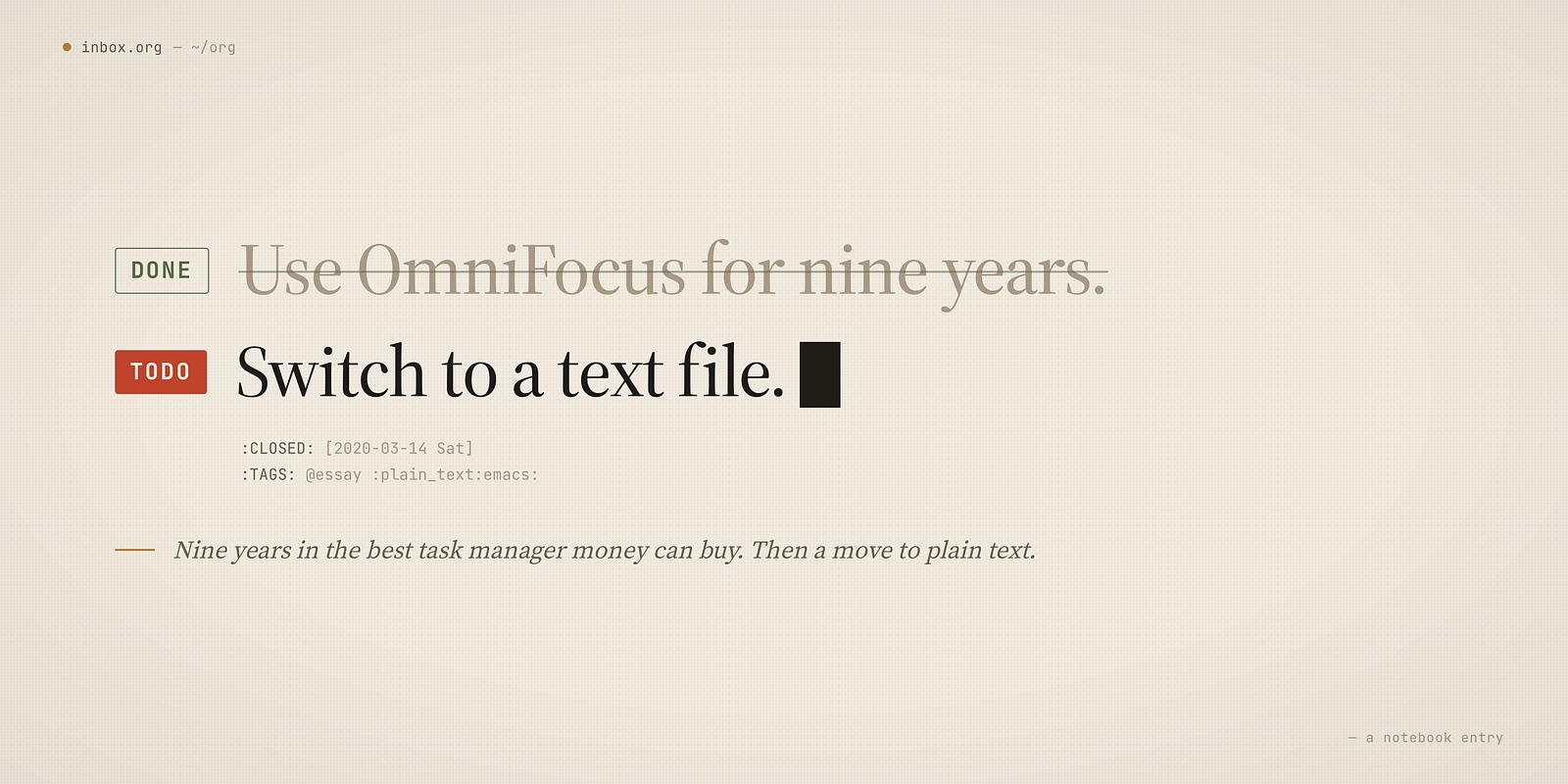
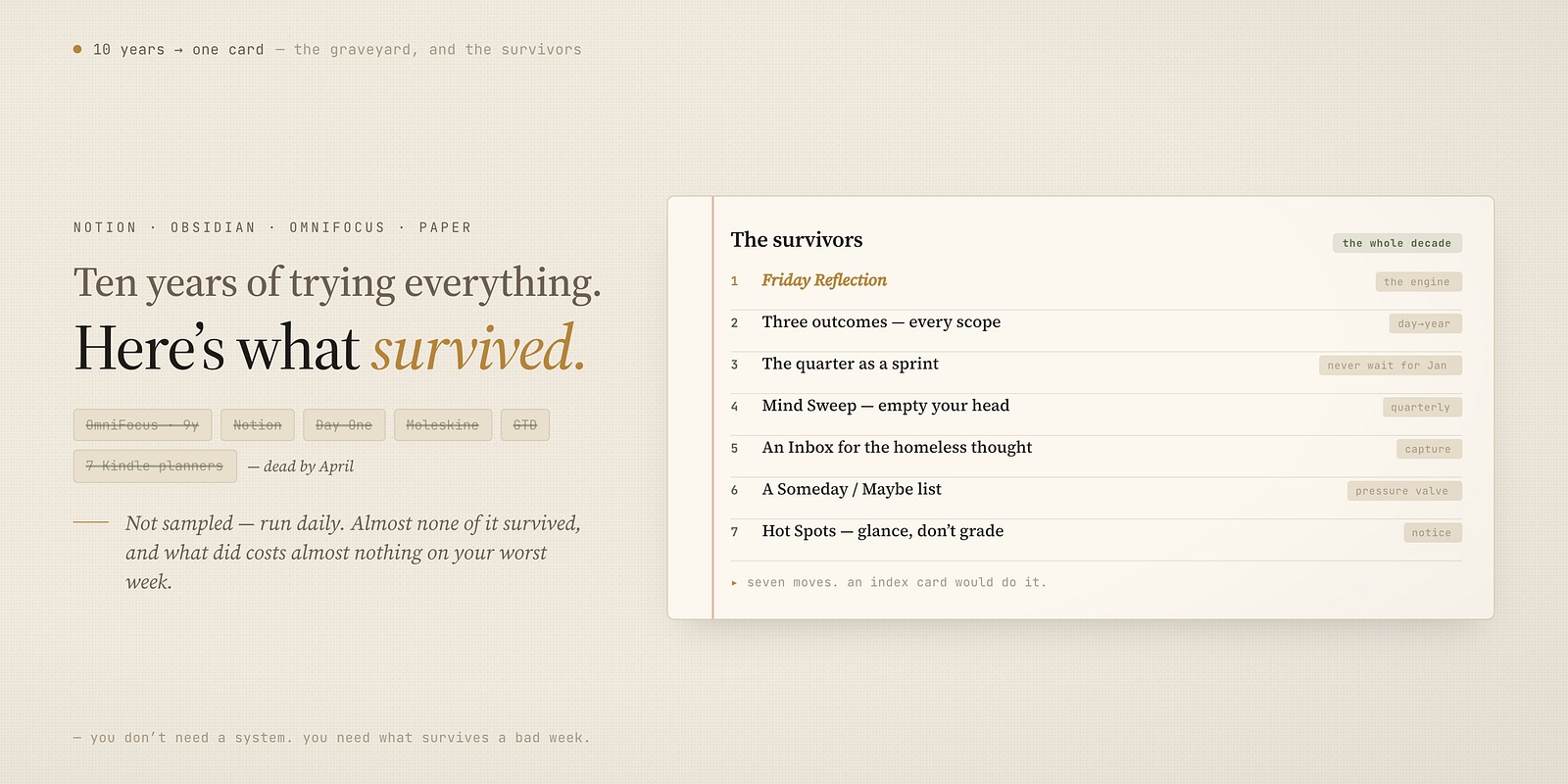
Nine years in OmniFocus. A long stretch in Notion. Obsidian, which I still open. Day One for my journal. A Moleskine in my bag for years before any of that. And last year, seven different planners on a Kindle Scribe — all seven dead by April.
I want to be precise about the difference between me and most “I tried every productivity system” posts, because it matters for whether you should believe a word of this. I didn’t sample these for two weeks each. I lived in them. Nine years is not an experiment; it’s a decade of my working life with one app’s assumptions wired into my head.
And underneath the apps, I ran three actual systems, daily, for about ten years: Agile Results, The 12 Week Year, and Getting Things Done — the one you’ve probably seen called GTD. Not read — run.
Here’s the honest result of that decade. Almost none of it survived. But the parts that did survive are the only productivity advice I’d still defend, and there are fewer of them than anyone selling a system wants to admit.
Getting Things Done (GTD)
What survived: the Mind Sweep, the Inbox, and the Someday/Maybe list.
The Mind Sweep is the single best idea in the whole genre. Sit down, empty your head onto a page, hold nothing back. It works not because it organizes anything — it doesn’t — but because a head full of unrecorded obligations is a head that can’t think. Ten years on, I still do this every quarter, and it still produces the same small shock of relief.
The Inbox survived for the same reason: one place where a thing can land before it has a home. Most systems fail at exactly this moment, when you have a thought and no legal place to put it.
The Someday/Maybe list is the one I’d argue hardest for, and the one most people skip. It’s where an idea goes when it’s real but it isn’t now. Without it you only have two options for a good idea — commit to it, or lose it — so you end up committing to things you had no capacity for, out of fear of forgetting them. Someday/Maybe is the pressure valve that lets you say “not this quarter” without saying “never.” Mine has things on it that sat for three years and then turned out to be exactly right. Nothing else in this article has quietly saved me more work.
All three of these are capture, and capture is where GTD is genuinely unbeatable. What keeps them from silting up is a weekly review — but the version of that I actually run came from somewhere else, and it’s the next section.
What died: the machinery. Contexts. The next-action taxonomy. The elaborate project-versus-subproject bookkeeping. All of it is coherent on paper and all of it collapsed the first genuinely bad week I had, because maintaining the system became a second job that competed with the work the system existed to protect.
That’s the pattern, and you’ll see it repeat: GTD’s habits held. GTD’s bureaucracy did not.
Agile Results
What survived: the Friday Reflection, three outcomes at every scope, and Hot Spots.
The Friday Reflection is the engine. If you take one thing from this entire article, take this one — it’s the practice that makes every other practice here worth anything.
It’s three questions on a Friday: what worked, what didn’t, what will I do differently. That’s the whole ritual, and it takes about ten minutes. What it does is convert a week of activity into something you can actually learn from. Without it you don’t get ten years of experience — you get one year, ten times, because nothing ever feeds back. Every other item on my list is a way of holding things: outcomes hold intent, the Inbox holds stray thoughts, Someday/Maybe holds the not-yet. The Friday Reflection is the only one that changes anything. It’s also what keeps Someday/Maybe from silting up into a junk drawer — you read the list, and every so often something graduates.
Three. Not a list — three. Three for today, three for this week, three for the month, the quarter, the year. It sounds almost too simple to be a method, and that’s exactly why it outlasted everything else I tried. A to-do list is infinitely expandable, which means it’s infinitely postponable. Three forces the decision that a list lets you avoid.
Hot Spots survived too — a short standing set of life areas (Mind, Body, Emotions, Career, Financial, Relationships, Fun) that you glance at rather than fill in. Not to score yourself. Just to notice, on a Tuesday, that you haven’t thought about one of them in six weeks.
What died: the vocabulary and the ceremony around it. The system has a lot of named rituals, and I gradually stopped performing any of them while keeping the number three. What I kept could be written on an index card.
The 12 Week Year
What survived: the quarter as a sprint.
This is the one idea I’d hand to someone who refuses to read anything else. A year is too long to plan honestly — you cannot see twelve months out, so you write fiction, and by March the fiction is embarrassing and you quietly stop looking at it. Twelve weeks you can actually see. And crucially: you never wait for January again. There are four fresh starts a year, and the next one is at most twelve weeks away.
What died: the scoring. Weekly execution percentages, tracked and graded. I did it for a long time, and what it mostly produced was a number I felt bad about, which is not the same as information. Some people thrive on it. After ten years I know I’m not one of them, and pretending otherwise was its own kind of procrastination.
What all three get wrong
Every one of these is sold as a whole system. Buy the book, adopt the framework, follow it completely — and the completeness is presented as the point. If it isn’t working, you’re told, you’re not doing all of it.
That’s exactly backwards. A whole system is the first thing real life breaks. The week your kid gets sick, or the project goes sideways, or you’re just flattened for reasons you can’t name — that’s the week the system needs to survive on 10% of its normal upkeep. And a system designed to be run completely doesn’t degrade gracefully. It shatters, you feel guilty, and three weeks later you’re shopping for a new one. That loop is the actual productivity industry.
The apps repeat the same mistake at a different layer. OmniFocus, Notion, Obsidian — genuinely good software, all of them, and I don’t regret a year of any of it. But every app arrives with its own opinion about how you should think, and a decade taught me that the opinion always outlives its usefulness before the app does. Notion wanted me to build databases. Obsidian wanted a graph. OmniFocus wanted perfect capture hygiene. None of those are wrong; they just weren’t mine, and eventually I was maintaining someone else’s model of my life.
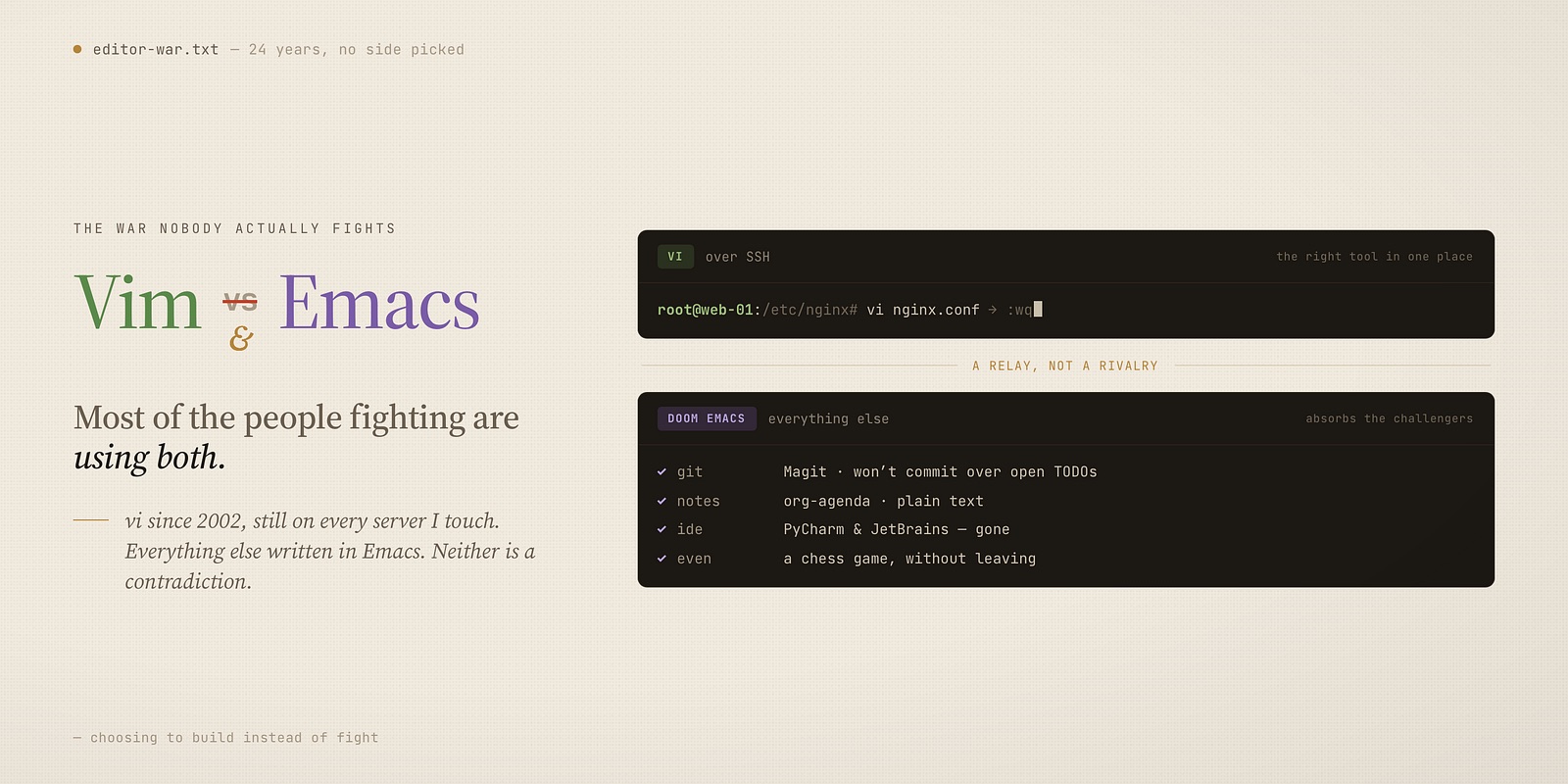
So most of my notes live in plain text now, where nothing has an opinion. And Obsidian is still installed — I open it to look at a folder visually and then close it, which is roughly 5% of what it can do, and exactly the right amount.
The survivors fit on one page
Ten years, and here’s the entire yield:
- A Friday reflection — what worked, what didn’t, what’s next. The engine. Everything else is inert without it.
- Three outcomes at every scope — day, week, month, quarter, year.
- The quarter as a sprint. Never wait for January.
- A Mind Sweep to empty your head, every quarter.
- An Inbox for the things that don’t have a home yet.
- A Someday/Maybe list so a good idea doesn’t force a commitment you can’t make.
- Hot Spots to glance at, not to grade.
That’s it. That’s the decade. Seven things, and every one of them survived because it costs almost nothing to maintain on your worst week.
Which is a slightly deflating thing to discover after ten years — and also the most useful. You don’t need a system. You need the handful of moves that still work when you’re at your lowest capacity, because those are the only ones that will ever be there when it counts.
So I built the page
Here’s the part where I tell you I made something, so take it with the appropriate salt.
Those survivors needed a surface. I tried seven planners on my Kindle Scribe looking for one, and all seven died by April — not because they were badly made, but because each one was a whole system again, with pages I’d never fill and structure I’d have to maintain. So I built the one I actually wanted, called it Triada, and put nothing in it but the survivors: a Friday Reflection sitting one page after every Friday so the ritual is impossible to skip, three outcomes at every scope, quarterly Mind Sweep, an Inbox, and Hot Spots you glance at.
It’s a hyperlinked PDF, and that turns out to matter more than the device. On a Kindle Scribe you write straight onto every page with the pen, which is what I do. On an iPad it opens in any PDF annotation app and works the same way. And if you’d rather have paper — I carried a Moleskine for years, I understand completely — you print it. Same structure, whichever surface you actually reach for.
I’m not going to pretend it’s a better system than the three I took it from. It isn’t a system at all. It’s what was left after a decade of running theirs, arranged so it survives a bad week.
If any of the six survivors above sound right to you, take them. You genuinely don’t need my planner to use them — an index card works, and that’s not false modesty, it’s the whole thesis. But if you’d like them already laid out, that’s what I made.
If you want to see it
The free sample is the actual first ~62 pages: front matter, all of January, January Reflection, February’s Monthly Outcomes. Not a teaser. Not watermarked. You can use January from the sample as your real January.
- Free sample (Monday-start): triada-sample.pdf
- Free sample (Sunday-start, US/Canada): triada-sample-sunday.pdf
- See the full edition + device variants: https://maxclax.com/triada
Thanks for reading. Follow on X: https://x.com/maxclaxOS
Dotfiles: https://github.com/maxclax/dotfiles
Related: