
 TEMPO
TEMPO
 SUNCLAX
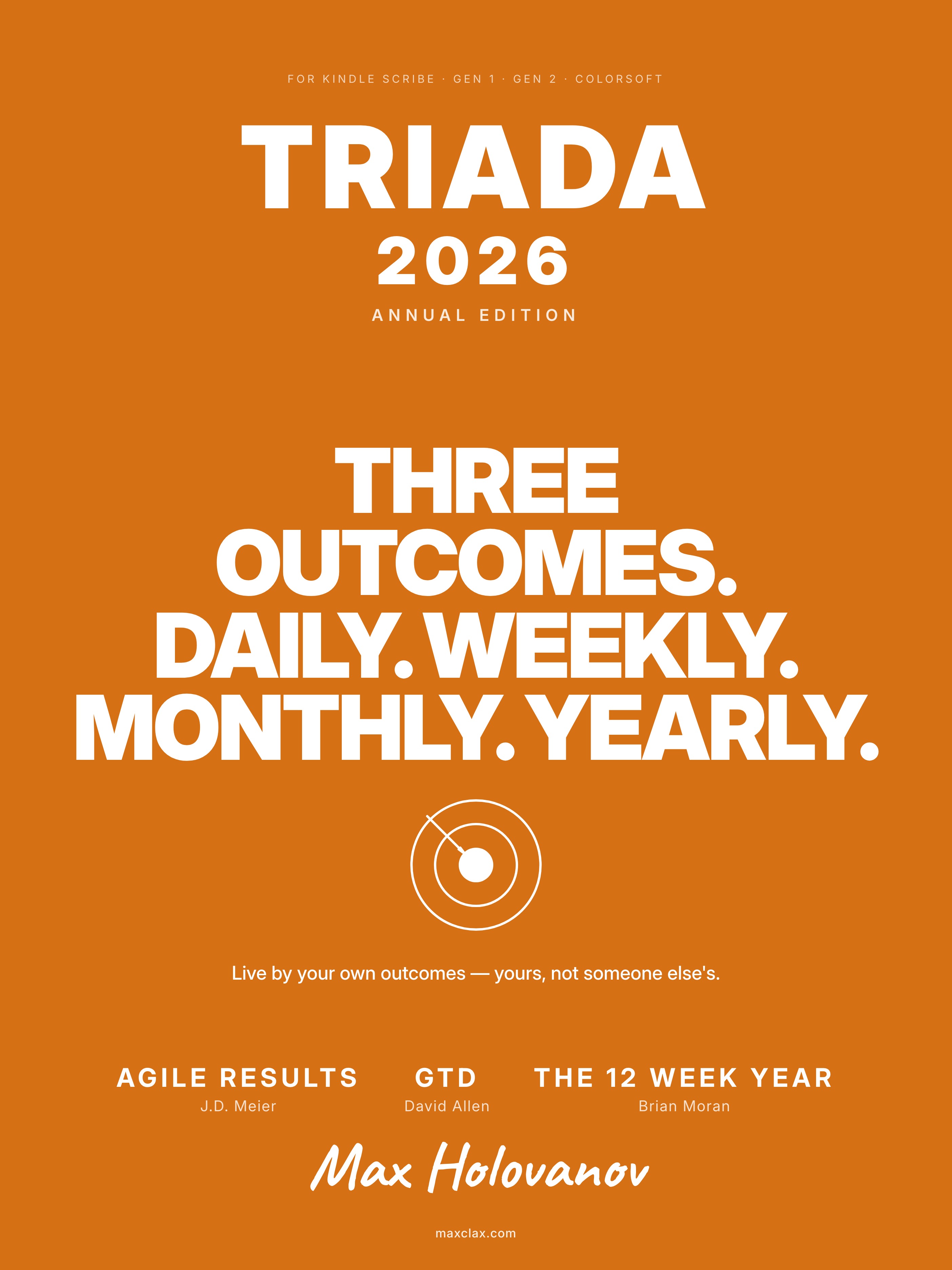
TRIADA
Three outcomes.
That's the whole year.
Live by your own outcomes — yours, not someone else's.
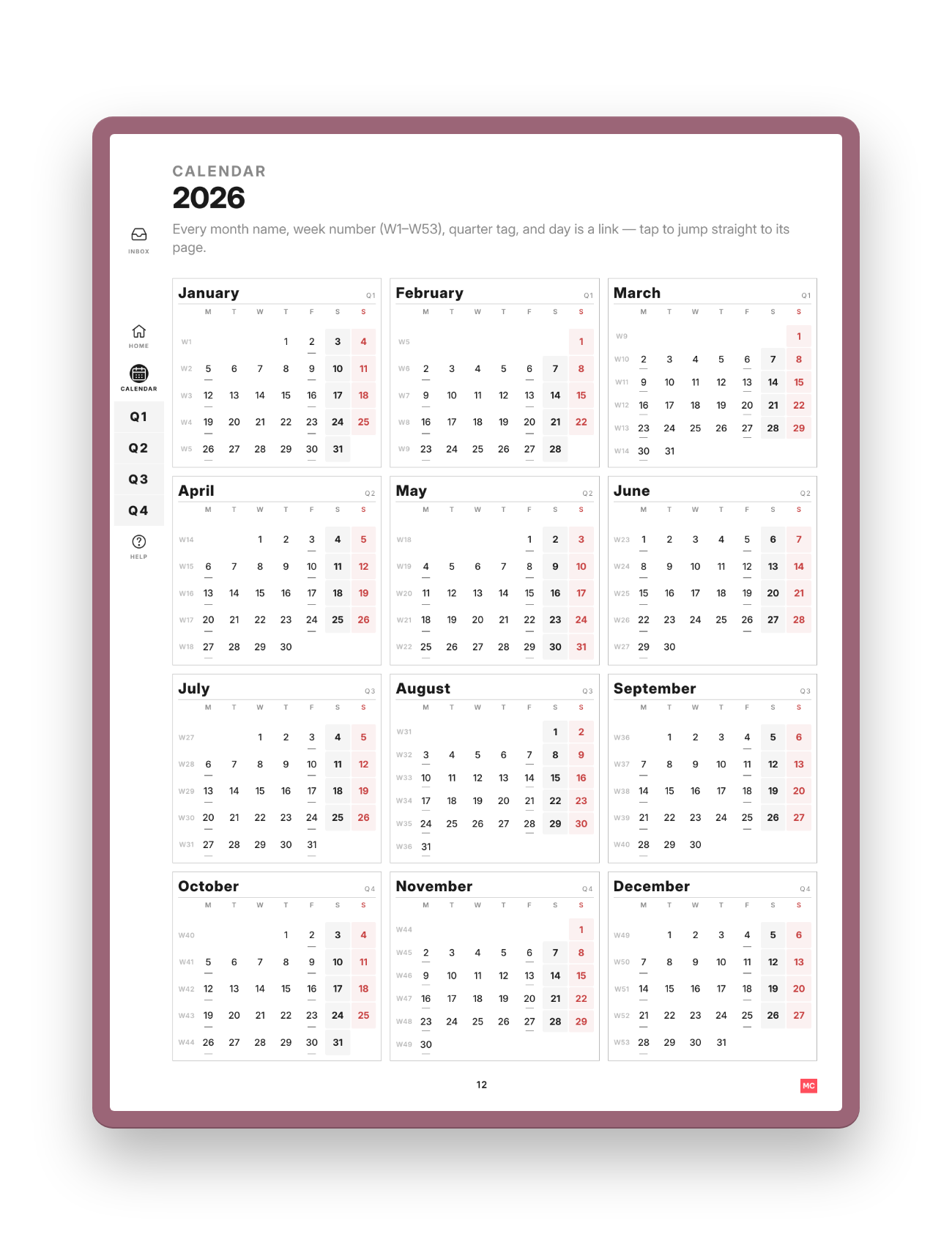
A hyperlinked planner for Kindle Scribe, reMarkable, iPad, Supernote or Boox.
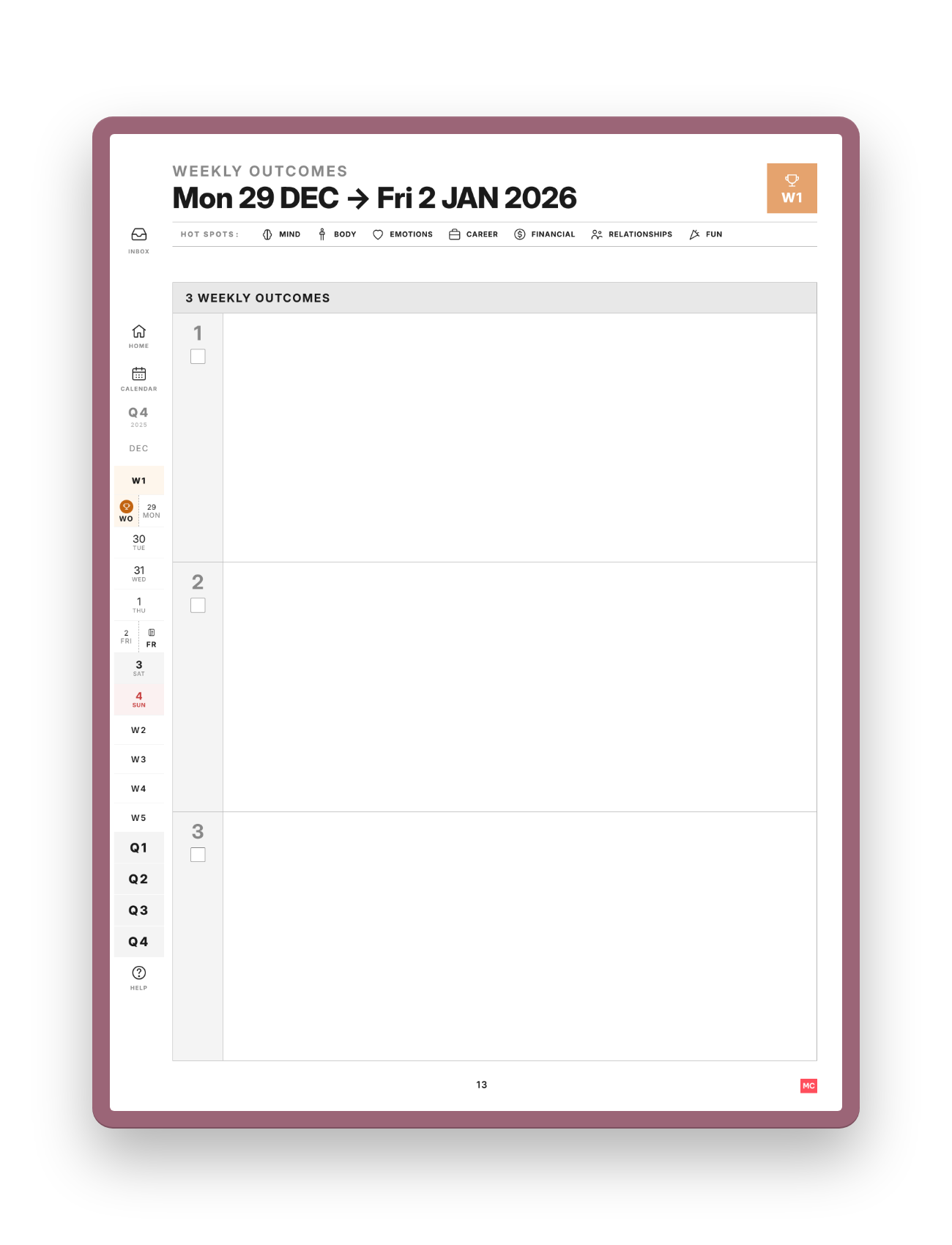
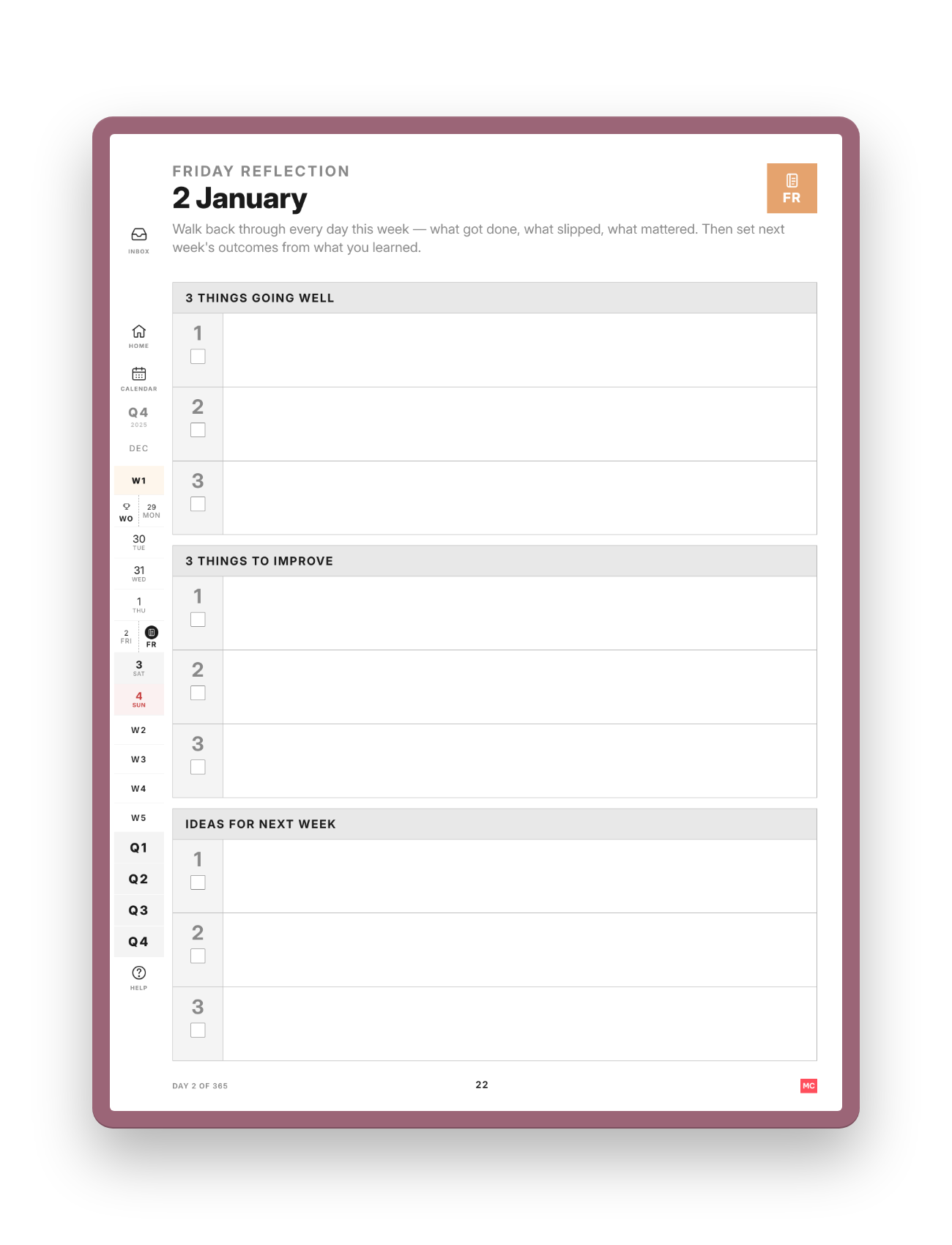
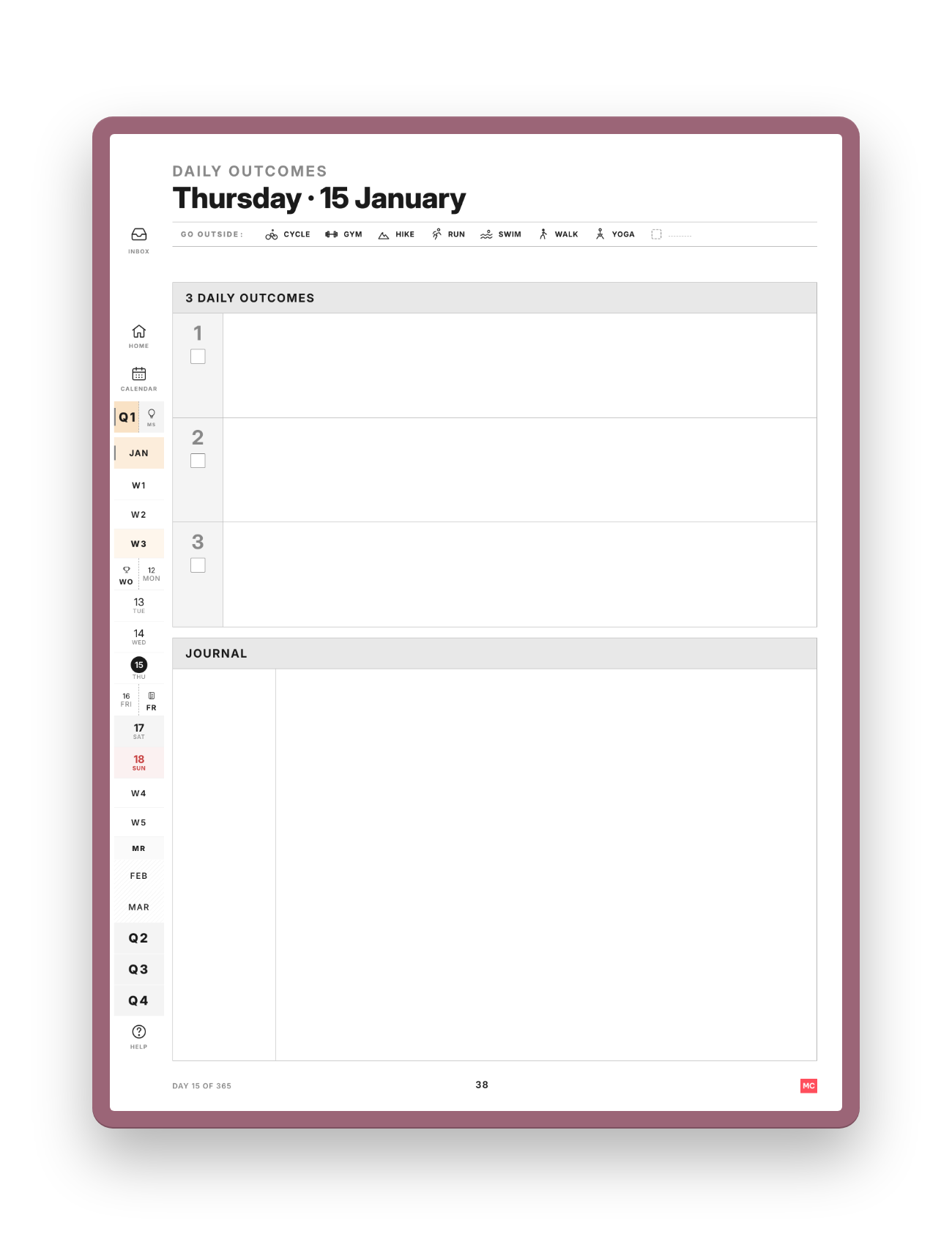
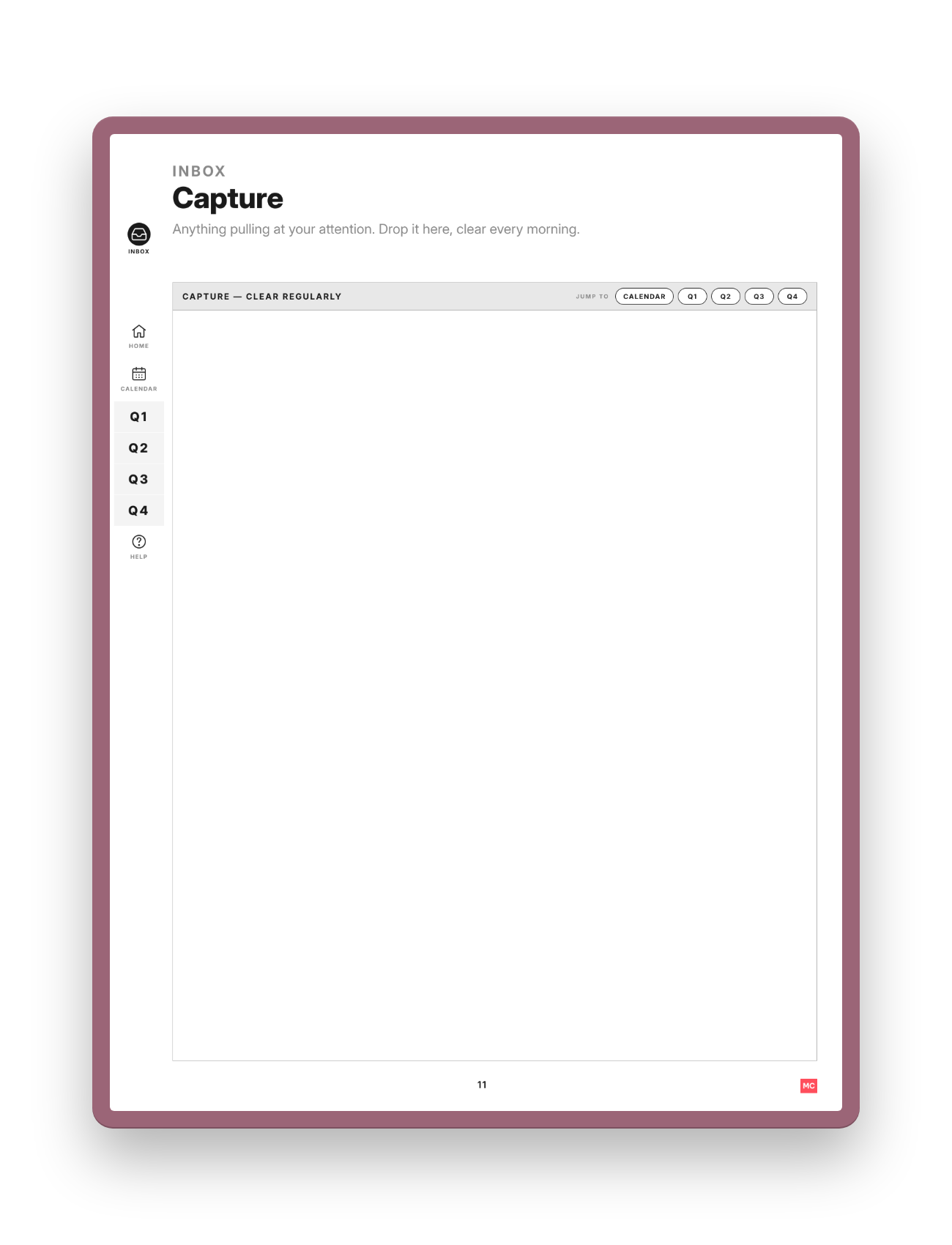
The Rule of Three.
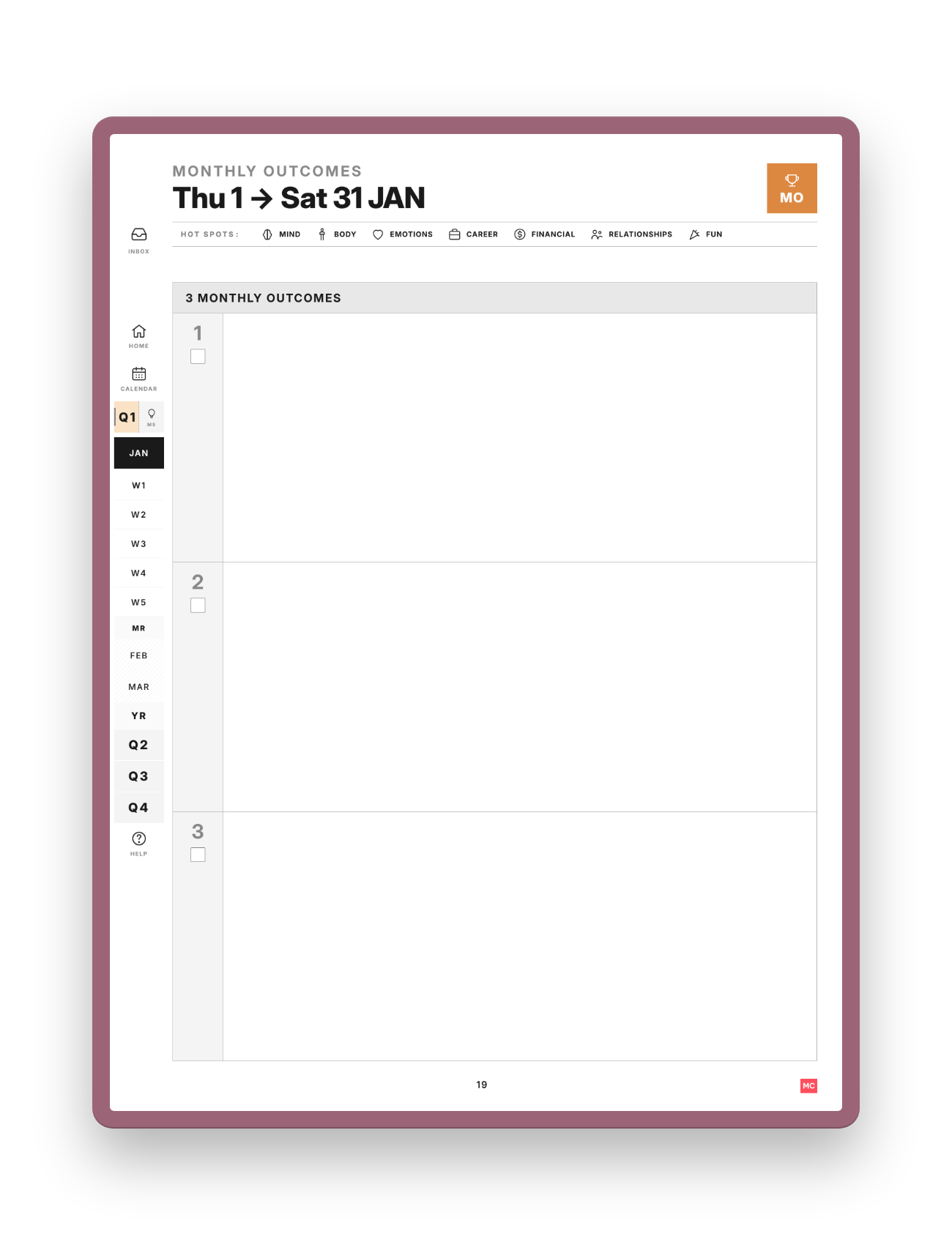
Not a bottomless to-do list — three things that make the day count. The same three at every level:
Day → Week → Month → Year
Built on
Agile Results
J.D. MeierThe Rule of Three. Three outcomes for the day, week, month, year. Three is the number your brain can hold while it lives the day.
GTD
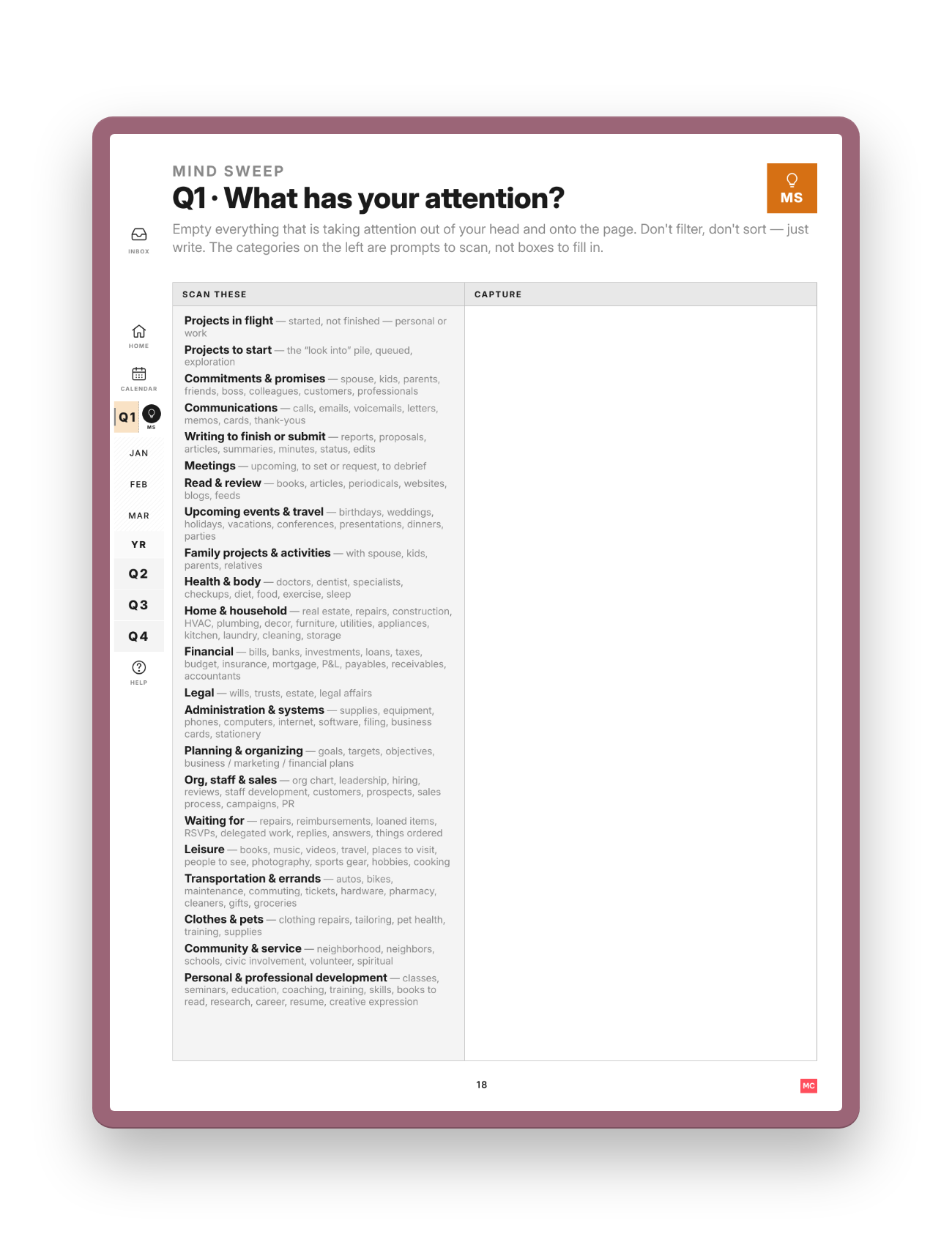
Getting Things Done · David AllenCapture everything, decide once, review weekly. The Inbox + Mind Sweep pages in TRIADA are the GTD discipline made tactile.
The 12 Week Year
Brian MoranYour year can be twelve weeks or the full twelve months. A closer outcome is a better outcome — urgency creates focus, distance creates drift.
Books behind TRIADA — the reading list on Amazon
Why it survives.
No streak shame.
No trackers made to stare back at a skipped day. Miss a day — open the next one.
A sidebar on every page.
Tap a quarter, a month, a week, a day — you're there. No scrolling thirty pages to find a Tuesday.
Reflection is built in.
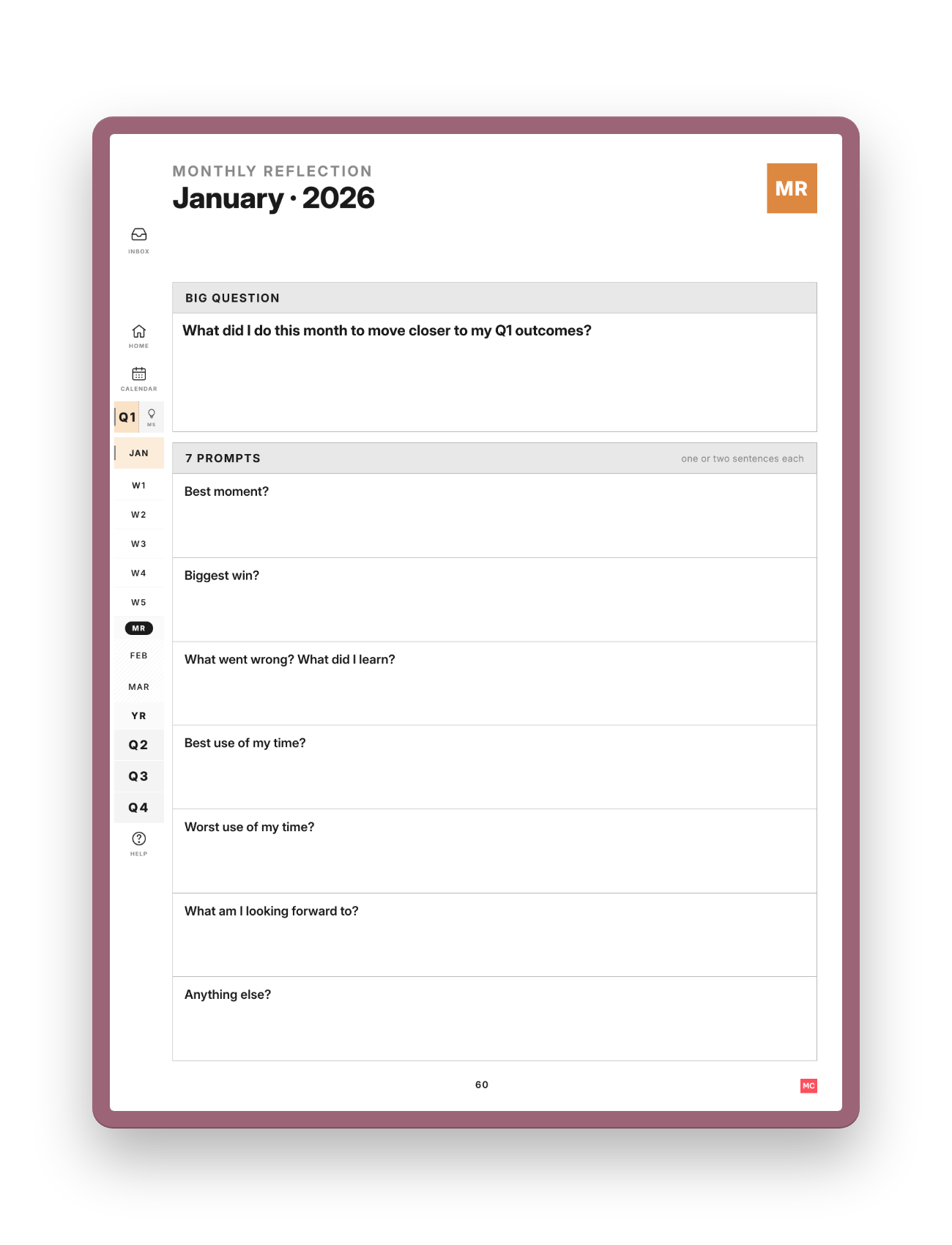
Friday, month-end, year — each loop closes where you are.
An inbox for the rest.
Capture what lands on you, pull one item into today, work it while your three outcomes stay in view.
It's a PDF.
No app, no login, no subscription. Write on it with your pen.
You need a system.
You need Triada.
Most planners quit on you by March. The habit tracker becomes a wall of red Xs. The 'new year, new me' notebook ends up in a drawer. Willpower runs out by Wednesday.
A system doesn't run on willpower. It runs on one small action you can repeat on your worst day: open the page, write your three.
Only when it matters.
I write only when there's something real to share — an outcome I shipped, a decision I changed, or a question worth re-asking. No schedule. No noise.
FAQ
Why outcomes, not goals?
Goals are intentions. Outcomes are receipts. A goal is what you said you'd do in January. An outcome is what you can point at on Friday and say I shipped that.
The grammar matters: each outcome is written in the past tense, as if already done — I have shipped X, I have called Y, I have walked Z. That single shift is what separates this planner from every January-resolution notebook.
Today is not the start of the year — is it too late to start?
No. Start any Monday — your year is the next 12 weeks. Whatever the date, most of the quarter is still ahead. Pick three outcomes today and ship them in the weeks remaining.
Every day you postpone for the “clean start” proves the case for a yearly horizon — the exact thing this system was built to escape. Start now, imperfectly, with whatever date the calendar shows.
Open the next monthly outcomes page. Write three. The system starts the moment you put the pen down.
Why use a quarter as your year?
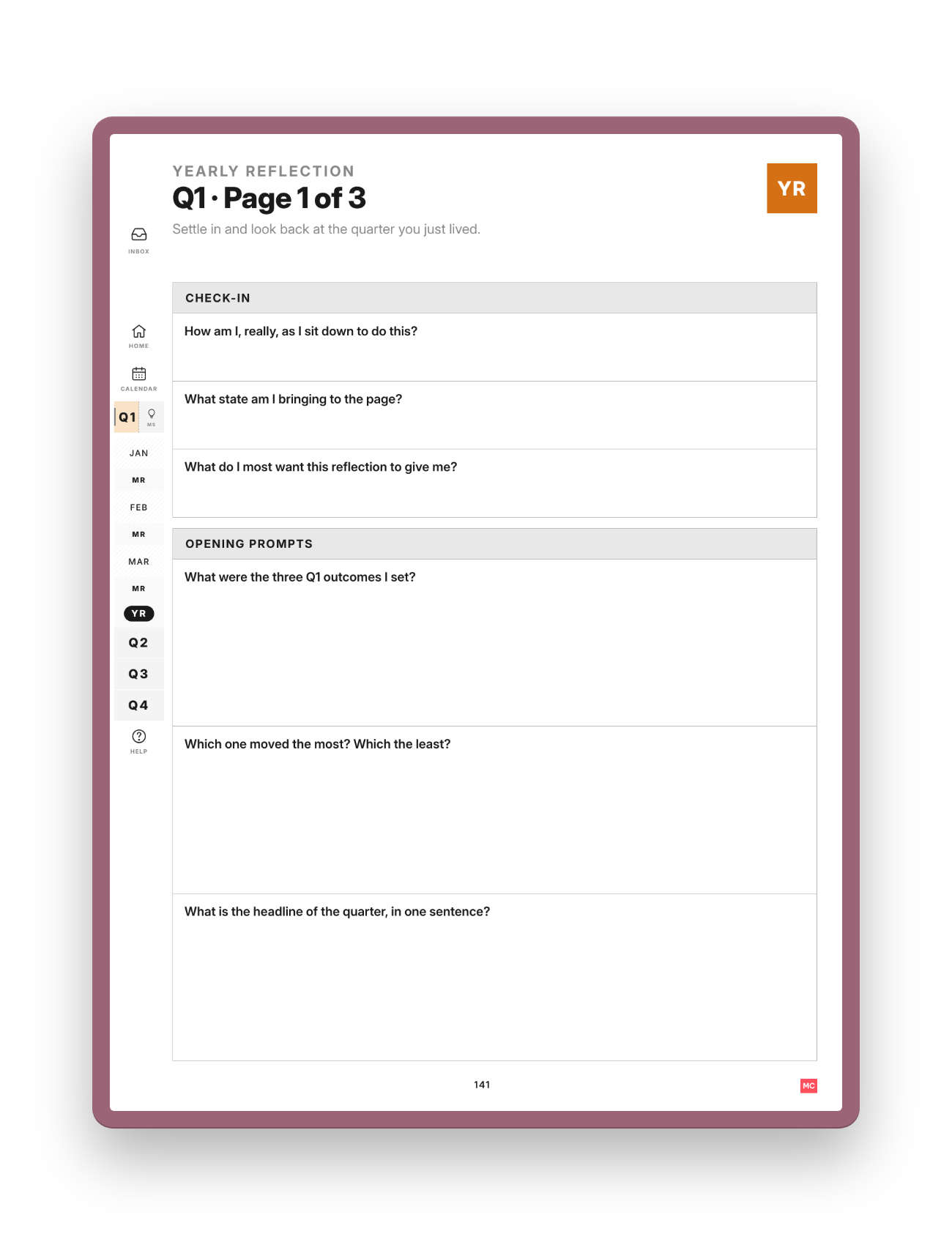
Because a year is too far away to feel real. By March your January goals already look like someone else's. A quarter — 12 weeks — is short enough that you can hold the goal in your head every single day, and long enough to actually ship something.
This is the core idea of The 12 Week Year by Brian Moran. Treat the quarter as your year. Three Yearly Outcomes that matter for the next 12 weeks. Everything below — monthly, weekly, daily — climbs toward them.
A closer outcome is a better outcome. Urgency creates focus. Distance creates drift.
Why three outcomes — not five, not ten?
The Rule of Three from Agile Results (J.D. Meier). Three is the number your brain can hold while it lives the day. Five is a list. Ten is noise.
Three forces you to choose. The choice is the work.
What if I miss a day, a week, a month?
Skip it — the next page is tomorrow. The planner is not a streak counter — it is a thinking surface.
If you miss a Friday Reflection, do it Saturday morning. If you miss a whole week, write next week's three outcomes and move on. The system survives gaps; perfectionism is what breaks it.
Why no time slots, no hourly schedule?
Because the day is not the hours — it is the three outcomes. If you nail the three, the hours take care of themselves. If you miss the three, no amount of color-coded blocking would have helped.
The Journal column on the daily page is yours. Put times there if you want them. Or notes. Or nothing.
Can I set tomorrow's daily outcomes the night before?
Why not? You'll do it from time to time — I do it too, on nights when I know the morning won't have the headspace. There's no rule.
What matters is the frame. Every page is a new page — not just in this book, but in your life. Don't write tomorrow's three outcomes from the weight of today's problems. Write the three that build your life forward, not the three that just react to what's broken right now.
Why Friday evening, not Friday afternoon?
Friday afternoon is still inside the work week — you can't see it yet. By Friday evening or Saturday morning the week has settled and you can read it honestly. Pick the moment that gives you distance, not the moment the calendar tells you to.
Should I make my daily outcomes and journal look pretty — drawings, calligraphy, decorations?
Don't try to be an artist here. The page is not the point. The moment your mind reacts to it is.
Write in whatever style your mind responds to. The handwriting that gives you a felt jolt when you re-read it next Friday — that is the right style for you. Neat, messy, all-caps, doodles in the margin — none of it matters except the response.
That moment of resonance is the engine of the whole system. It tells your mind what actually matters to you. It's the signal that lets you stop spending hours on outcomes that aren't yours — the ones you wrote because someone else expected them, or because they sounded reasonable on paper.
If a page leaves you flat when you re-read it, the issue isn't the style. It's that the outcome wasn't yours in the first place. Rewrite it.
What's the “Why not” row on top of the Daily Outcomes page — do I have to do something every day?
No. You don't have to go anywhere. The row is a reminder, not a mandate — no streak to break. The icons sit at the top of every daily page so the option to move is right in front of you when you open it.
How to use it: on days you actually move, mark the icon for what you did. The last slot is blank — write in your own activity if the presets don't cover it. On days you don't move, leave the row. No guilt.
What it gives back: at the end of the week, flip through the 7 daily pages and you see at a glance how many days you moved. The only goal worth having here is do a little more this week than last. Small, visible, honest.
Can I start using this before I've read the books?
Yes — start today. This planner is already the shortest distillation of the three books; you can run the system without ever opening them.
The books make you more confident in the system, not more capable of using it. Read them when you want the why, the edge cases, and the muscle memory for when life pushes back. Not before.
Which book should I read first — and why does the order matter?
Start with Getting Results the Agile Way by J.D. Meier. No exceptions. Of the three books on this list, AR is the only one that gives you a complete system on its own. The other two work as extensions to it, not as replacements. Read AR first and a lot of the productivity systems you've already tried can quietly retire — including most of GTD.
My own path was the long way around. I met GTD first and used it everywhere — first with OmniFocus on iPhone, then I moved everything to org-mode in Emacs. It worked for managing the inbox. But when I picked up AR, it clicked from day one in a way GTD never did. The reason is simple: GTD organizes tasks. AR organizes outcomes. Tasks pile up. Outcomes finish.
Then I read The 12 Week Year and kept exactly one principle from it: treat the quarter as your year. That single move speeds AR up by 4× — same outcome thinking, with the year-long horizon collapsed to something your brain can actually feel.
So the recommended order is: AR end-to-end (it's the foundation), then 12 Week Year (just for the quarter horizon — most of the rest you can skim), then GTD (cherry-pick the inbox / weekly-review habits and leave everything else). This planner is what falls out of those three reads.
Can I print this and use it on paper?
Honestly — I can't recommend it. This planner is built around the sidebar. Most of the time you don't read pages in order; you jump. And you jump a lot during reflection — digging for ideas across past weeks, comparing months, looking back at previous outcomes. That jumping is what makes the system work, and on paper it falls apart: there's no tap target, no quick path back.
If you still want to try: stick tabs on the edges of the key pages — each quarter's outcomes, each month-end and quarter-end reflection — to fake the sidebar's quick-jump. It'll be slower than tapping, but workable.
Up to you. I just can't recommend it.
What do all those short labels mean — Q1, W23, WO, FR, MR, YR, MS?
Short labels are how the sidebar fits four quarters, twelve months, and 52 weeks into a column you can tap with your thumb. Once you know the shorthand, the whole planner is one tap away.
Q1–Q4 are the quarters, JAN–DEC the months, W1–W53 the weeks — each one jumps to its outcomes page. WO is Weekly Outcomes, FR Friday Reflection, MR Monthly Reflection, YR Yearly Reflection (your end-of-quarter look back), MS Mind Sweep.
Four icons — Calendar, Home, Help, Inbox — sit in the sidebar on every page. Each language edition has its own short labels, and the FAQ inside the planner explains every one.
Which languages is TRIADA available in?
Five — English, Українська, Deutsch, Español, Русский. All five are in every purchase; pick yours inside and switch anytime.
The Russian edition is for readers who open with «Слава Україні». If not — the other four are yours.
Will it work on my device?
It's a hyperlinked PDF, fitted to your screen:
- Kindle Scribe · Gen 1 · Gen 2 · Colorsoft
- iPad · with Apple Pencil
- reMarkable 2 and reMarkable Paper Pro
- Supernote · A5X · A6X · Nomad · Manta
- Boox · Note Air · Tab Ultra · Note Max · Go
- Any PDF app on Android, Windows or Mac
Weeks start on Monday. A Sunday-start version comes in English only.
Do I get 2028?
On the Lifetime edition, yes — free, automatically. New years land in your download the moment they're ready, and we email you when one does.
On the 2026 + 2027 edition, you have those two years for keeps. Either way, 2027 comes with 2026 included.
Pick your edition.
Kindle Scribe
Gen 1 · Gen 2 · Colorsoft
Same hyperlinked PDF runs natively on all three Scribe generations — no scaling, no letterboxing, no compromise.
reMarkable
reMarkable 2 · Paper Pro
Adapted for reMarkable's e-ink screen and stylus pressure.
Supernote
A5X · A6X · Manta
Same hyperlinked PDF runs natively on all three Supernote generations — no scaling, no letterboxing, no compromise.
Boox
Note Air · Tab Ultra · Go
Same hyperlinked PDF runs natively on Boox Note Air, Tab Ultra & Go — no scaling, no letterboxing, no compromise.
iPad
iPad · iPad Air · iPad Pro
Same PDF, hyperlinked navigation, in any iPad PDF reader.
Which week-start do you prefer?
TRIADA ships in two layouts. Pick the one your week follows.


