 SUNCLAX

Everyone Loves Obsidian for the Wrong Reason. So…
Obsidian didn’t invent this. You just forgot you had it.
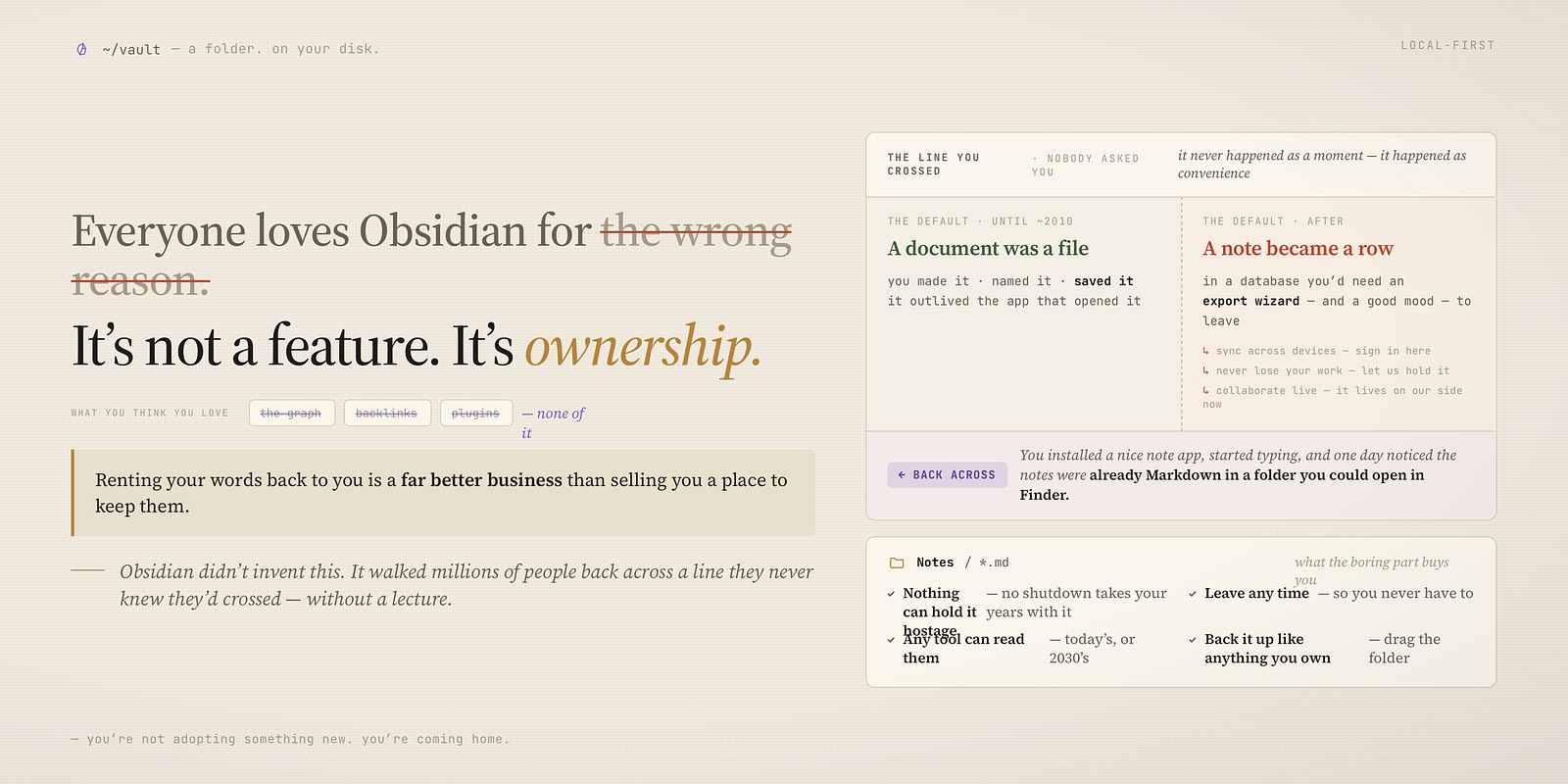
When people describe why Obsidian feels different, they reach for the graph, the backlinks, the plugins. That’s not it. The thing you actually felt the first time your notes showed up as plain files in a folder was older and quieter than any feature: these are mine. Nobody’s server, nobody’s database, nobody’s subscription. A folder. On your disk. That you could copy to a USB stick and walk away with.
That feeling isn’t new. It’s the oldest feeling in personal computing, and you had it long before anyone said the word “vault.” A document used to be a file. You made it, you named it, you saved it, and it sat on your machine whether or not the company that made the app still existed. That was just how computers worked. It wasn’t a philosophy. It was the default.
We didn’t choose the cloud. We were moved into it.
Somewhere in the last fifteen years the default flipped, and almost nobody noticed the moment it happened, because it never happened as a moment. It happened as convenience.
Sync your notes across devices — sign in here. Never lose your work — let us hold it. Collaborate in real time — of course it lives on our side now. Every step was a real improvement, and every step also moved the thing you wrote a little further from you and a little closer to a company’s balance sheet. Your words stopped being files and became rows in a database you’d need an export wizard, and a good mood, to ever get back out of.
Nobody sat you down and asked, “Would you like to stop owning your writing?” If they had, you’d have said no. Instead the question was never asked, because the answer was assumed the day the business model required it. Renting your own words back to you is a far better business than selling you a place to keep them. So that’s the deal we drifted into — not because it was better for us, but because it was better for them, and it was dressed up as better for us convincingly enough that we stopped checking.
What Obsidian actually did
Here’s the part worth being precise about, because it’s the whole reason the app matters more than its feature list suggests.
Obsidian’s real achievement isn’t the graph. It’s that it walked millions of completely normal, non-technical people back across a line most of them didn’t know they’d crossed — and did it without a lecture. You didn’t have to care about file formats. You didn’t have to learn a terminal. You just installed a nice-looking note app, started typing, and one day noticed the notes were sitting right there, as Markdown, in a folder you could open in Finder. No permission needed. No export. They were already yours because they were never anything but files.
That’s a magic trick, and the trick is that there’s no trick. The most-loved feature of the most-loved note app of this era is a plain folder of text — the thing computers gave everyone for free in 1995, handed back to a generation who’d been quietly taught that their writing belonged to a login screen.
You can keep the graph. You can ignore every plugin. The part that actually changed your relationship to your own words is the boring part: they’re files, and you have them.
What that quietly buys you
Strip away the tech and here’s what lands in a normal person’s lap the day their notes become plain files — none of it requiring you to understand a single thing about formats:
- Nothing can hold your writing hostage. No app can go under, get bought, or hike its price and take your years of notes with it. The words sit in a folder that outlives the software.
- You can leave any time — so you never have to. There’s no export wizard to dread, because there’s nothing to export. That freedom is exactly why you stop feeling trapped enough to want to use it.
- Any tool can read them — today’s or the one that ships in 2030. Search them with anything. Point any AI you trust at them. Open them in an app that doesn’t exist yet. Plain text outlives every program that ever touched it.
- Back them up like anything you own. Drag the folder to a drive, a USB stick, another machine. It’s yours to copy, not a login you hope still works.
- You stop paying rent on your own thoughts. The words you wrote aren’t a subscription. They’re just… there. Free, in the oldest sense of the word.
That’s the list, and notice what’s not on it: features. This is why people who “can’t explain why they love Obsidian” love Obsidian. They’re not in love with the graph they never open. They’re in love with the feeling of standing on their own ground for the first time in a decade of note apps — they just don’t have the words for it, because nobody sold it to them. It arrived for free, underneath everything else.
Why the people who build software never left
Now the tell. Ask who was already living this way the entire time the rest of us were migrating into rented rooms, and you get one answer: the people who build the software.
Watch how a developer treats the work they genuinely cannot afford to lose. Their code is plain text in a folder. Their configuration — their whole machine, the way I keep mine — is plain text in a folder. It’s versioned, backed up, copied between machines, and it’s in formats that will still open in thirty years because a text file has no company attached to it that can go out of business. Nobody who understands how software actually decays keeps the important stuff locked inside one vendor’s app. They keep it in the plainest format that works, on disk, under their own control. That’s not paranoia. It’s just knowing where the bodies are buried.
So it’s not a coincidence that Obsidian became beloved by exactly this crowd first — the developers, the “tools for thought” builders, the people fluent enough in software to have opinions about data formats. They didn’t fall for a clever app. They recognized an old friend. Obsidian was simply plain-text-in-a-folder with a good face on it, and the face was for you, not for them. There’s even a name for the movement the builders talk about among themselves — local-first — and it’s just the polite engineering term for the thing your grandfather’s word processor did by accident: keep the data on the user’s machine, in a form the user owns.
When the people who make the rented tools quietly keep their own real thinking in plain files, that’s the review that counts. Not the marketing. The habit.
Ownership is a feeling, not a feature
Here’s what nobody puts on the landing page, because you can’t screenshot it.
Owning your files is a feeling. It’s the small, specific calm of knowing that nothing you rely on can be repriced next quarter, sunset in a blog post, sold to a company with different plans, or locked behind a tier you didn’t have last year. It’s the difference between a home and a lease, and once you’ve felt the home version you can’t un-feel how tense the lease one always quietly was.
You stop bracing. You stop keeping one eye on the pricing page. You stop the low background hum of “what happens to all of this if they go under, or get bought, or just decide.” Because the answer became: nothing happens. It’s a folder. It’s on my disk. It’ll be there.
That’s the thing Obsidian actually gave a lot of people back — not features, but the ability to stop bracing. And it turns out that’s not a productivity upgrade. It’s closer to relief.
This is a return, not a revolution
If you want to see the far end of this idea — the fully unrented version — it’s a folder of plain-text files where your notes, your tasks, your journal, and your calendar are all just text you own, nothing in the chain, no company anywhere in the picture. That’s what org files in Emacs are, and it’s the most complete expression of “these are mine” I’ve found.
But this isn’t a pitch to switch to Emacs — most people shouldn’t, and that’s a different essay. I bring it up only to show the direction the line runs, because the interesting thing is that the whole industry is slowly drifting back along it. Local-first is a real movement now. “Own your data” is a selling point again. Apps are competing on how little of you they hold. Day by day, the default is bending back toward where it started — files, on your machine, in formats that outlive the app — and it’s bending back not because a company got generous but because enough people remembered the feeling and started asking for it.
That’s the part I’d want you to keep. Not a tool. A direction.
You already stepped back across the line
So no — Obsidian didn’t invent owning your files. It couldn’t have. Owning your files is the thing you had before anyone convinced you to hand it over, and all Obsidian really did was make the trip home comfortable enough that you’d actually take it.
If your notes are plain files in a folder right now, you’ve already done the meaningful part. You’re back on the side of the line where your words are yours, where no login screen stands between you and your own sentences, where the app is a guest in your folder instead of a landlord over your data. Keep that. Guard it a little. It’s older than the cloud that made you forget you had it, and it’s worth more than any feature anyone will try to rent you on top of it.
The instinct is right: your words should be files you own. You’re not adopting something new. You’re coming home.
Thanks for reading. Follow on X: https://x.com/maxclaxOS
Dotfiles: https://github.com/maxclax/dotfiles
Related: