 SUNCLAX

Why Your Planner Doesn’t Work: It Only Knows L-Mode
The idea never shows up at your desk
Notice where your best thinking actually happens. Almost never at the desk, staring at the problem. It arrives in the shower, on a walk, half-asleep, in the exact moment you stopped trying. The solution you couldn’t force at 4pm turns up on its own at 7, unbidden, while you’re doing the dishes.
That’s not laziness or luck. That’s a different part of your thinking finally getting a turn — the part your entire productivity setup is built to shout over.
Two modes, and a book that names them
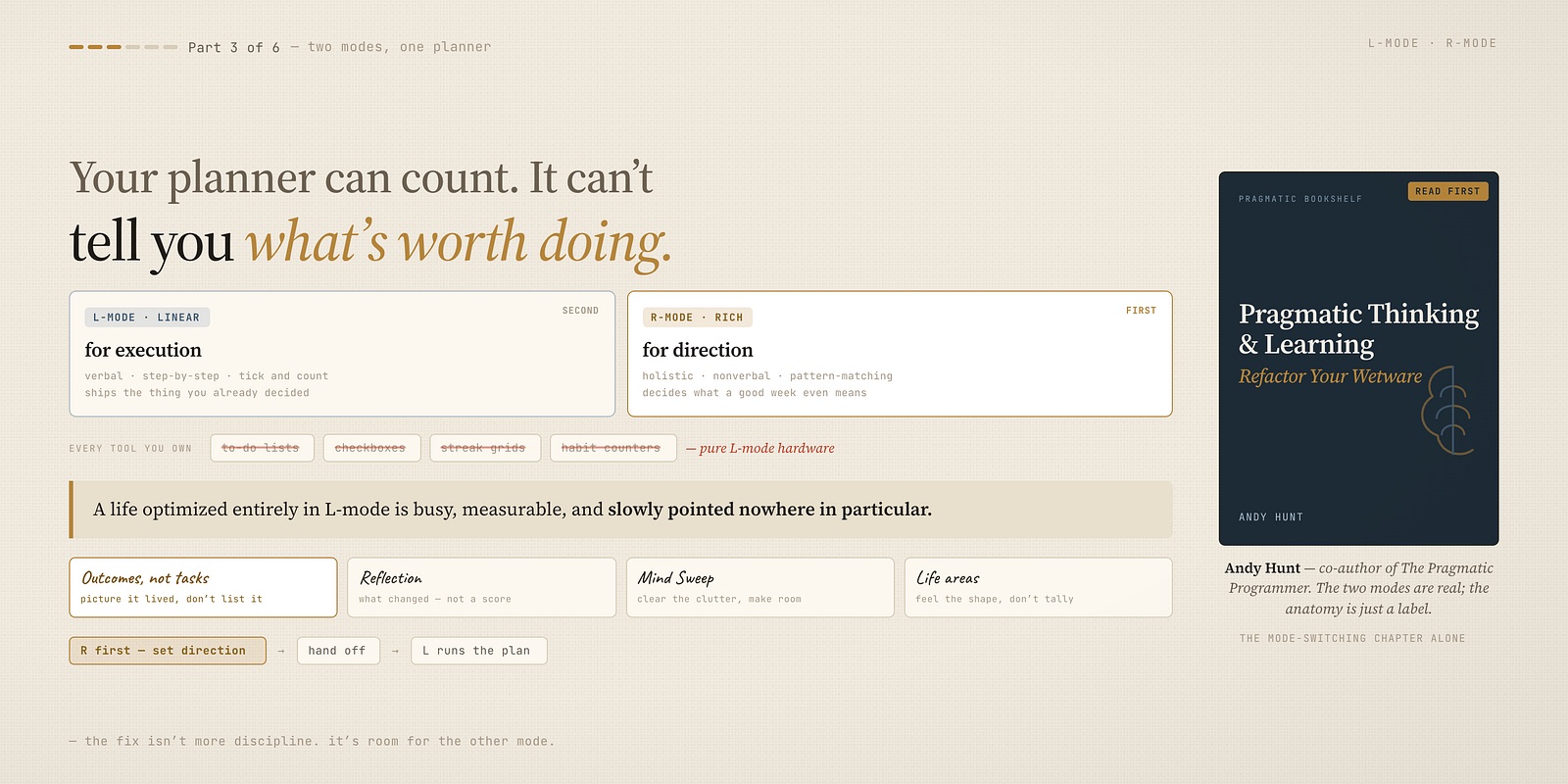
Andy Hunt — one of the authors of The Pragmatic Programmer — wrote a follow-up called Pragmatic Thinking and Learning: Refactor Your Wetware. Its most useful idea is a simple split between two modes your mind runs in.
L-mode — linear. Verbal, analytic, step-by-step, logical. It handles language, follows procedures, executes a plan, checks the boxes. It’s the mode you’re in when you write the code, answer the email, work the list.
R-mode — rich. Intuitive, holistic, nonverbal, pattern-matching. It sees the whole picture at once, makes the unexpected connection, notices what actually matters. It’s the mode behind the shower insight and the “wait — the real problem is something else entirely.”
(One honest caveat Hunt is careful about: this isn’t the pop-science “left brain / right brain.” L and R are names for two processing modes, not two halves of your skull. The neuroscience of hemispheres is messier than the metaphor. The two modes are real; the anatomy is a label.)
The right mode for the right job
The point isn’t that one mode is better. It’s that each is right for a different job, and using the wrong one is where the friction comes from.
L-mode is what you want for execution: shipping the feature, running the checklist, doing the thing you already decided to do. Try to run that on pure intuition and you drift.
R-mode is what you want for direction: deciding what’s worth doing, seeing the pattern across a messy month, the creative leap, the design that reframes the problem. And here’s the trap — you cannot brute-force R-mode with L-mode tools. You can’t checklist your way to an insight. You can’t tick a box marked “have a good idea.” Sit and grind at a creative problem in pure L-mode and you get a tidier version of the wrong answer.
Most of us are fluent in switching modes for work. Almost nobody switches them on purpose for their own life.
Almost every productivity tool is pure L-mode
Look at what the tools actually are. To-do lists. Checkboxes. Streak grids. Habit counters. Notifications. Every one of them is L-mode hardware: linear, verbal, tick-and-count. They are superb at execution and completely blind to direction.
So you end up with a system that can tell you whether you did the fifteen things — and has nothing to say about whether they were the right fifteen. It runs your life like a build script and never once asks what you’re building. A streak grid is L-mode distilled: count, tick, don’t break the chain. It cannot hold a single R-mode thought, because R-mode doesn’t come in checkboxes.
That’s the quiet cost. A life optimized entirely in L-mode is busy, measurable, and slowly pointed nowhere in particular.
You can’t force R-mode — you make room for it
Hunt’s practical point is that R-mode won’t come on command. You coax it. You step back, you go quiet, you stop pushing. You write by hand instead of typing. You imagine instead of listing. You let a question sit overnight and let the background process run.
And R-mode’s output is fleeting — the insight surfaces and, if you don’t catch it in the moment, it’s gone by the time you’re back at the keyboard. Which is why the other half of the skill is capture: a place to put the shower thought before it evaporates.
None of that fits in a checkbox. All of it fits in a page.
How Triada opens R-mode on purpose
This is the whole reason the planner I built, Triada, is shaped the way it is. It’s not a tracker. It’s a set of deliberate R-mode invitations, each followed by an L-mode hand-off.
- Outcomes, not tasks. You don’t list what to do — you picture the day you actually wanted to live and write it as if it already happened. “Finish the report” is L-mode. “I sent the report and left work light, head clear for a long evening” is R-mode: an image, a whole scene, not a box. The imagining is the R-mode move.
- Reflection instead of scoring. The Friday and monthly reflections don’t count anything. They ask what changed, what mattered, what the month taught you — pattern questions, the thing R-mode is built for and a grid can’t touch.
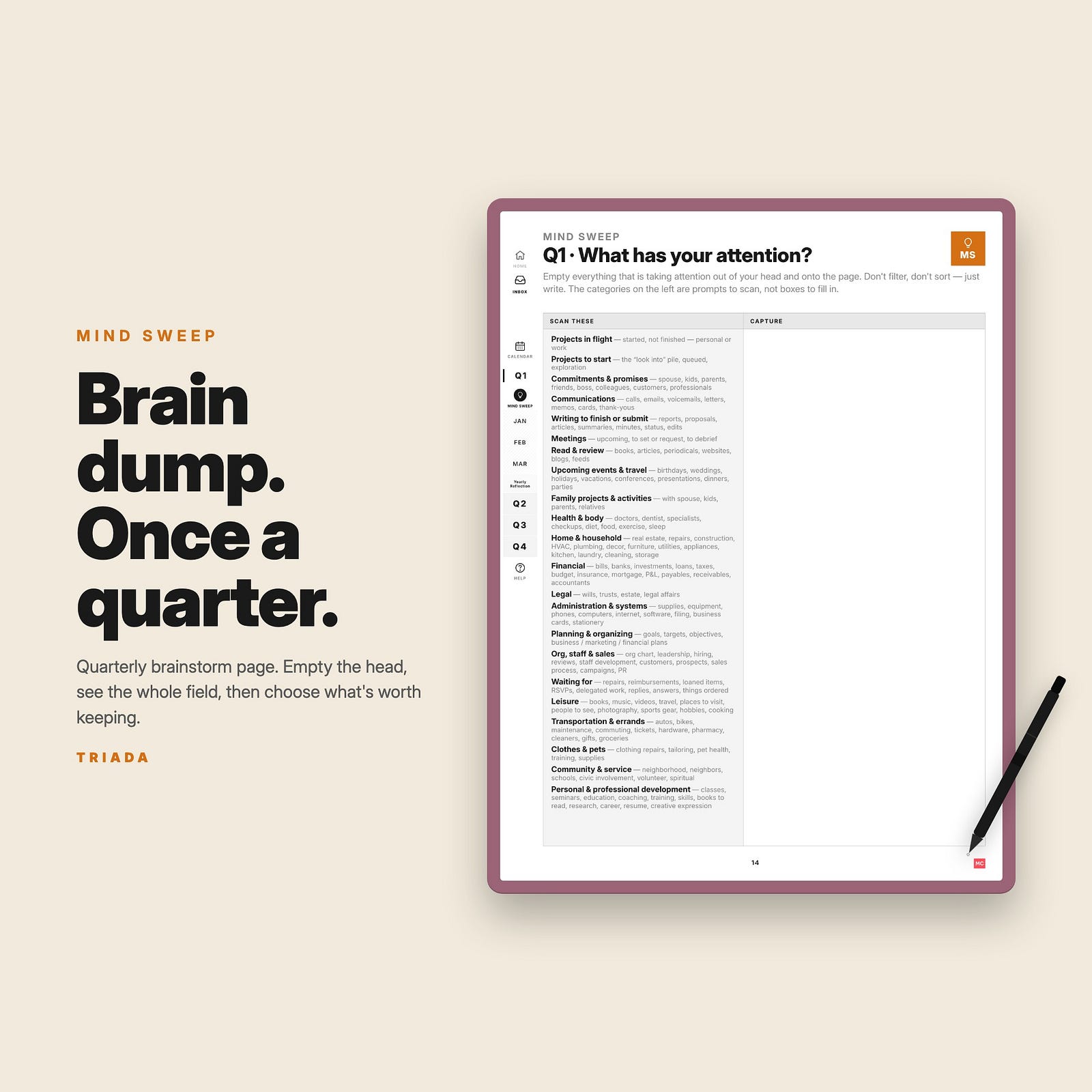
- The Mind Sweep. Once a quarter you empty everything out of your head onto a page. That’s not organizing (L-mode) — it’s clearing the L-mode clutter so R-mode finally has room to breathe. A mind full of open loops can’t do rich thinking.
- The life-areas check. A row across the week — mind, body, work, relationships, and the rest — that asks you to feel the whole shape of a life at a glance, not tally it. Holistic by design.
- No streak grid, anywhere. The one pure-L-mode fixture that every other planner ships, left out on purpose, because it crowds out the mode that actually sets your direction.
- Handwriting on e-ink. Writing by hand on a calm, single-purpose surface — no notifications, nothing to click away to — is exactly the low-pressure space Hunt says R-mode needs. It also catches the fleeting thought before it’s gone.
Both modes, in the right order
To be clear: L-mode isn’t the villain. You still need it — the three outcomes you set are useless until L-mode goes and executes them, step by linear step. The failure mode is running your whole life in L-mode and never giving R-mode its turn.
The right order is R first, then L. R-mode decides what a good week even means; L-mode then goes and does it. A planner should host that handoff — open R-mode to set the direction, then get out of the way and let L-mode run the plan. Most tools skip straight to the running and wonder why the direction is missing.
The takeaway
The skill the book is really teaching is switching modes on purpose — knowing when to think in straight lines and when to stop forcing them and let the rich, quiet mode do its work. Your tools should help you do that. Most only know one mode, and it’s the one you were already good at.
If your planner has never once asked you to imagine, reflect, or empty your head — only to tick — it’s running you in L-mode all day. The fix isn’t more discipline. It’s a little room for the other mode.
Thanks for reading. Follow on X: https://x.com/maxclaxOS
- Free sample (Monday-start): triada-sample.pdf
- Free sample (Sunday-start, US/Canada): triada-sample-sunday.pdf
- See the full edition + device variants: https://maxclax.com/triada
Dotfiles: https://github.com/maxclax/dotfiles
Related: