 SUNCLAX
Medium Sends Readers to My Blog. The Canonical Link Keeps the Credit There.
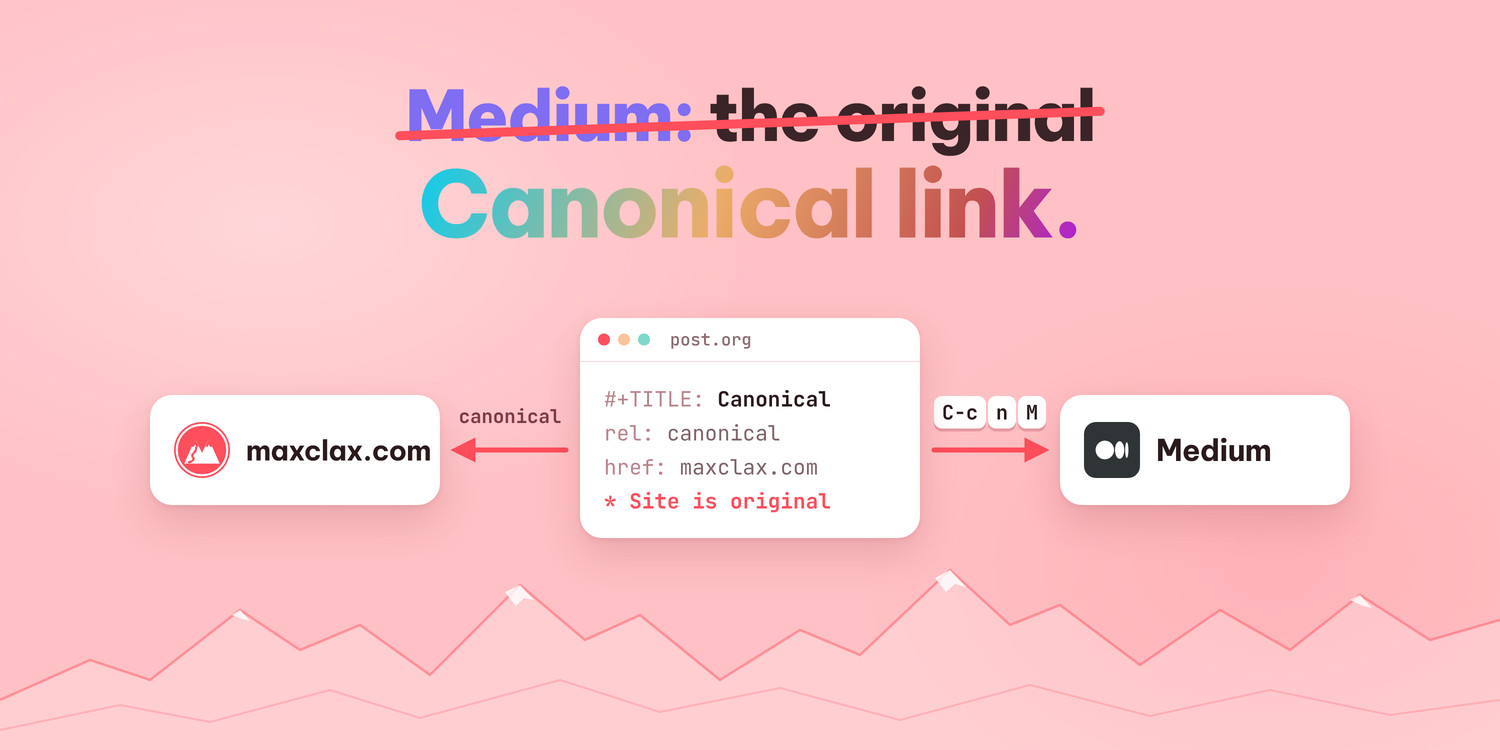
Every post I write lives in two places. The original is on maxclax.com. A copy is on Medium, because that is where a lot of readers are.
Two copies of the same text sounds like a problem for search. Which one is the real one? Which one should Google show? The answer is one small setting on Medium: the canonical link.
I wrote about my whole publishing setup in Obsidian Publish Costs $8 a Month. My Blog Runs on Org Files. This post zooms in on the canonical part, and on what my stats show after a few days of running it.
What a canonical link is
A canonical link is one line in the head of a web page. It says: this page is a copy, and the original is over there.
It looks like this:
<link rel="canonical" href="https://maxclax.com/blog/<slug>/">
Search engines read it as a strong hint. When they find two pages with the same text, they try to show the original and give it the credit, such as links pointing to either copy. The copy can still exist and still be read. It just does not compete with the original.
My blog pages point to themselves. The Medium copy points to my blog. So both sides agree on where the original lives.
How Medium sets it
Medium has two ways to do this.
The first is the import tool. You give Medium the address of a post, for example https://maxclax.com/blog/<slug>/, and it pulls the post in and sets the canonical link to that address by itself.
The second is the one I use. I paste the post into a new story, and then I set the canonical link by hand. In Story settings, under Advanced settings, there is a field for it. I check the box that says the story was originally published elsewhere and paste the site address.
I prefer pasting because my copy comes straight from the Org file, with pictures and links already fixed for Medium. Either way, the result on Medium is the same canonical line pointing to my site.
The note under the title
There is one more piece, and it is for people, not for search engines.
Right under the title of every Medium copy there is a short note: the post is free to read on my blog, with a link to it. I do not type it. When I press C-c n M in Emacs, the post goes to the clipboard as HTML, and that note is added at the top on the way.
I added it because of the paywall. Some readers hit it, and I would rather they read the post on my site than leave. It also turns Medium into a door to my site instead of a place where the reader stops.
What the numbers show
My site runs Umami, a small privacy-friendly stats tool. I pulled the numbers from September 20 to today, October 12.
For most of that time the blog was quiet. From September 20 to October 7, Medium sent only about 22% of the visits that came from other sites. Then I started publishing the blog first and Medium second, every time with the canonical link and the note.
Here are the daily visitors since then, as an index with October 8 at 100, and the part that came from Medium:
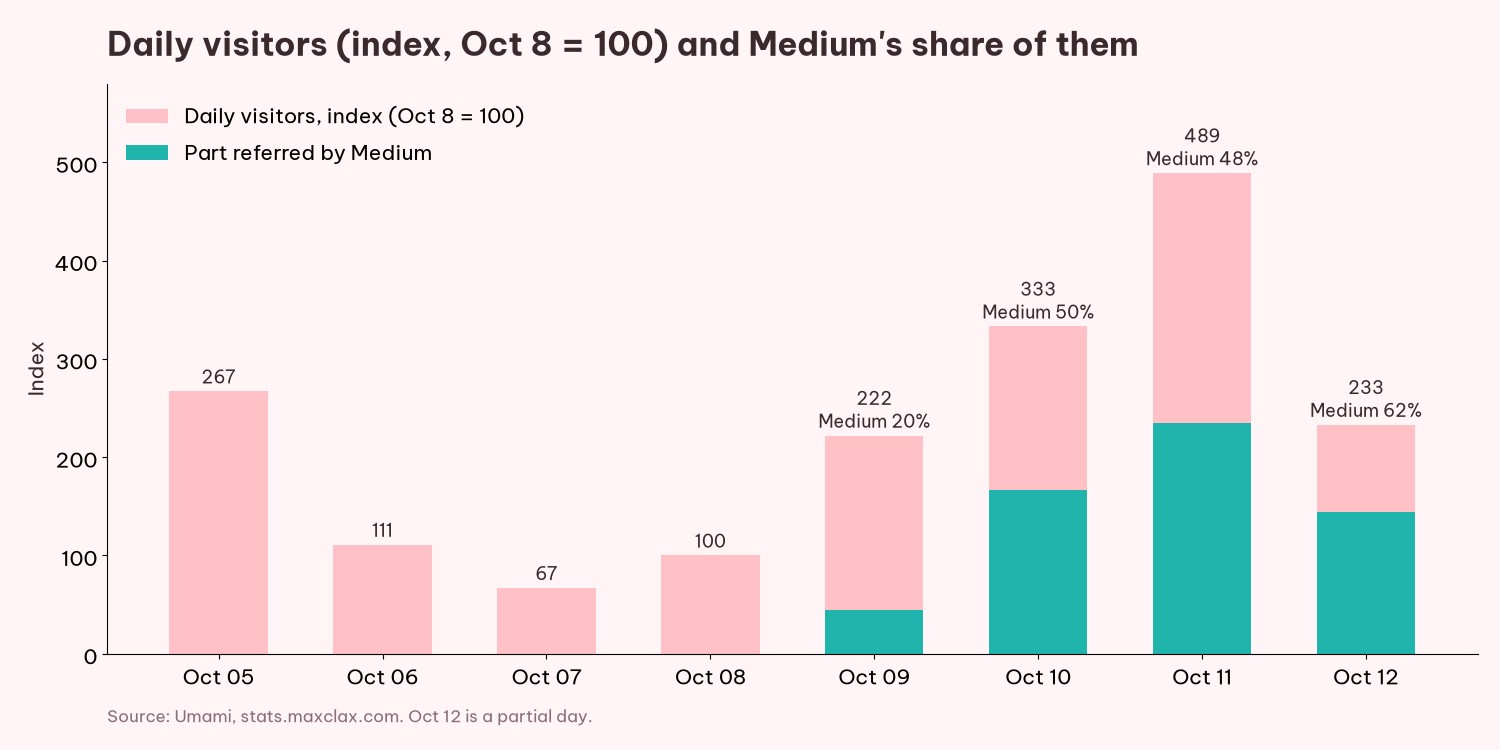
From October 8 to October 11, daily visitors grew almost five times. On October 11, close to half of all visitors came from Medium. Over those four days, Medium sent about 89% of the visits that came from another site. Today is not over yet, and so far about 62% of today's visitors came from Medium.
Medium shows up in my stats under two names: medium.com and blog.maxclax.com, my Medium publication. I count both as Medium.
Here is the share of referred visits by source, October 8 to 12:
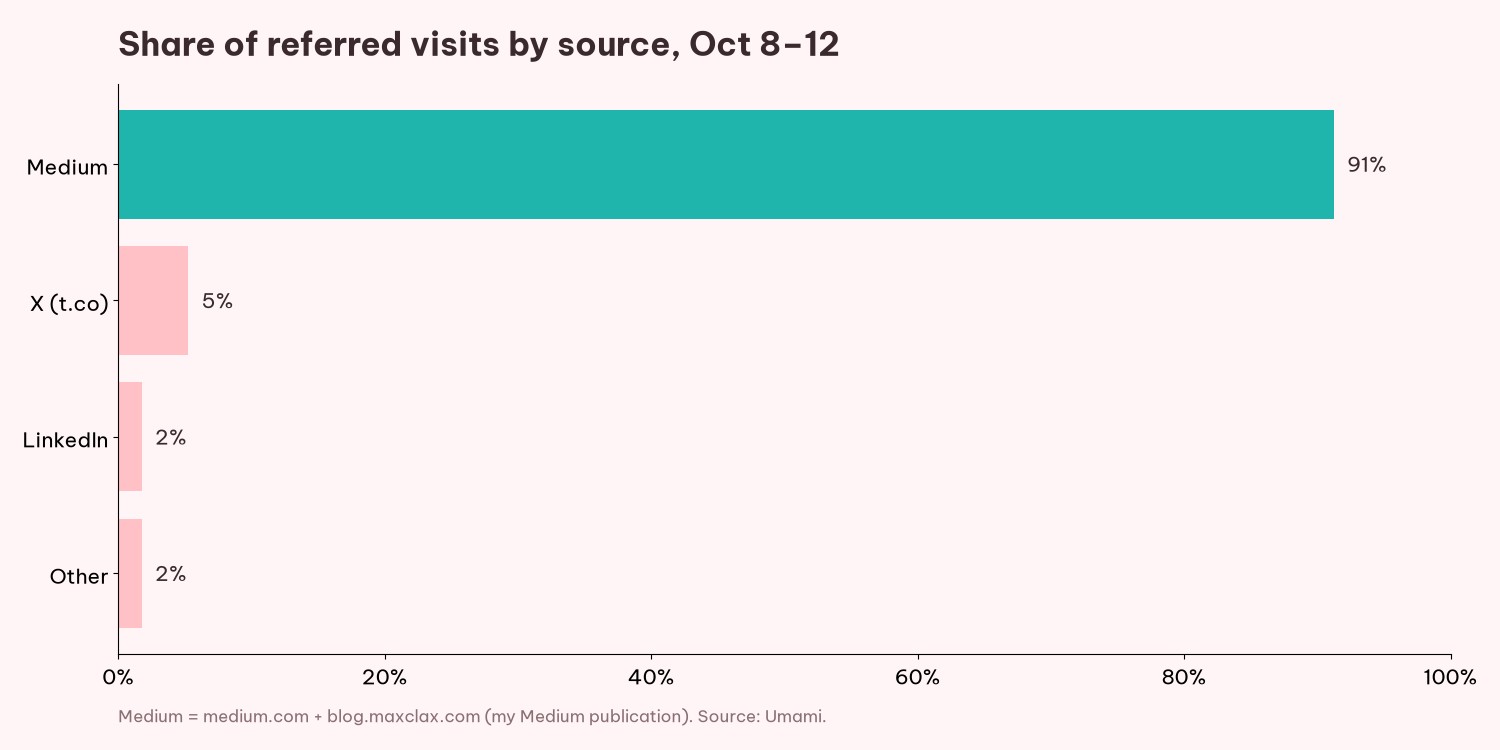
About 91% of referred visits came from Medium. X sent about 5%, LinkedIn and one other site about 2% each.
The most-read post in that time was Obsidian Was the Right First Step. Then Emacs Changed My Life, by a wide margin. Next came Obsidian Is Brilliant. I Use It as a Finder, and I Counted Every Key on a Saturday.
So Medium is doing the job I wanted. It brings readers. The readers land on my site. And the canonical link tells search engines that the site copy is the one that counts.
Honest limits
This is a small sample. My blog is young, a few days are a start, not a trend, and one good day can change every percentage here.
Referrers are not complete. Many apps and some browsers do not send them, so some Medium readers surely show up as direct visits. The real Medium share could be higher, but I cannot prove that.
Umami only sees my site. People who read the whole post on Medium and never click through do not appear here at all. Medium has its own stats for that.
A canonical link is a hint, not an order. Google usually follows it, but it decides in the end. I do not have search numbers yet that show the credit landing on my site, so for now that part is what the setting is for, not something my data proves.
And the readers do not do much more yet. Signups to my blog list and clicks on "Read on Medium" from the site are still rare. That is honest, and it is fine for now.
What I take from it
Cross-posting does not have to mean giving your writing away. One field in Medium's settings keeps the original on my site. One line under the title invites readers over. And the numbers so far say that most of the people who arrive from somewhere else arrive from Medium.
If you cross-post, set the canonical link every time. It takes ten seconds, and it is the difference between a copy and a competitor.
The code is in my dotfiles, if you want to copy it: C-c n M is my/org-copy-rich-html-for-web in init-org.el, and the key bindings are in +keys.el.
Thanks for reading. Follow on X: https://x.com/maxclaxOS