 SUNCLAX

Obsidian Was the Right First Step. Then Emacs Changed My Life.
Every note app is selling you AI over your own notes right now. If you moved to Obsidian, you already dodged the trap that makes that upsell work — your notes are files, and any AI can read a file. That was the right call. It was also, for me, only half the move.
If you moved to Obsidian, you were right
Let me start where most of the internet currently is: Obsidian.
It deserves the hype. It’s the best-looking, most capable note app a lot of people will ever use, and — more importantly — it got one enormous thing right that almost nothing else did. Your notes are Markdown files, in a folder, on your disk. Not rows in someone’s database. Not a proprietary blob you’d have to fight an export wizard to extract. Files.
That sounds like a small technical detail. It’s the whole ballgame, and this year it finally became obvious why.
What everyone is selling you right now
Look at what note apps are shipping in 2026. AI. AI over your notes. A paid assistant that will answer questions about words you wrote, in a database you filled, for a monthly fee on top of the monthly fee.
I kept everything in Notion for a while, and I liked it — the databases, the nested pages, the way a blank page turned into a little app if you leaned on it. Then a small, uncomfortable question caught up with me: where do the words actually live? Not the pretty interface. My sentences. And the answer was: on someone else’s server, in a shape only their app could read.
That’s not a home. That’s a lease. And Evernote already showed a whole generation how the lease ends — sold, repriced, features migrating up into higher tiers, and an export that felt like a fight when people finally left. Nothing illegal, nothing even surprising. Just what a landlord does when they own the building and you own the boxes inside it.
Now stack the AI upsell on top of that and look at how strange it is. It’s my knowledge. My writing. And to point an intelligence at it, I have to rent a second thing from the same landlord — because the data sits in a shape only their tools can open. I can’t bring my own model. I can’t say “I already pay for an AI I trust, let it read my notes.”
That upsell only works on rented data. That’s the part worth sitting with. The lock-in isn’t a side effect of the AI feature — it’s the precondition for it.
Which is exactly what Obsidian already fixed for you
So when I say Obsidian people made the right move, I mean something specific. You didn’t just pick a nicer app. You removed the hostage.
Because your notes are plain files, any intelligence can read them. The Claude subscription you already pay for. A local model running on your own machine with nothing leaving the house. grep, when you just want to find a word. And the tool that doesn’t exist yet — the one you’ll want in three years — will read them too, because plain text outlives every app that ever opened it.
Notice what that does to the pitch: it removes its leverage entirely. Nobody can pressure you into renting AI over your notes when your notes were never the hostage. You choose the editor. You separately choose the AI. Neither one can hold the other one captive.
Obsidian’s business is sync and publishing — conveniences it sells you on top of files you’d still own if you never paid a cent. That’s a fundamentally different relationship than one built on holding your words. Credit where it’s due.
I still have it installed, in fact. I open it to see a vault visually, drag a screenshot from one project into another, and close it again. It’s genuinely good at that.
But that’s roughly where it stopped being the center of my life, and here’s why.
The ceiling nobody warns you about
Obsidian freed my files. It didn’t free my workflow.
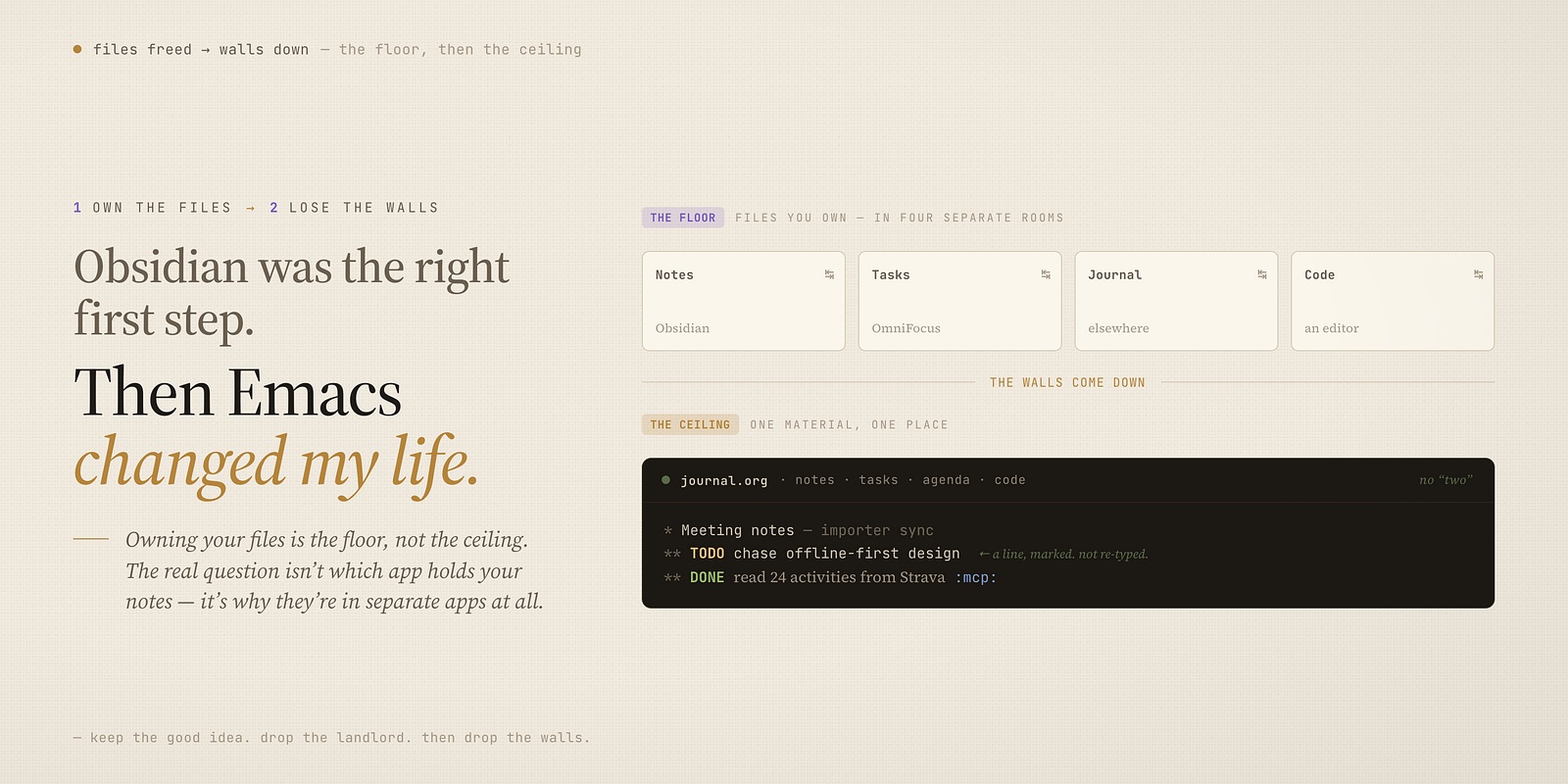
Here’s what I mean. My notes were finally mine, sitting in a folder — and they were still in an app I had to go into. Notes lived in Obsidian. Tasks lived in OmniFocus. My journal lived somewhere else again. Code lived in an editor. Four separate rooms, four separate habits, four separate places to look for a thing I half-remembered.
So the friction moved. It stopped being “can I get my data out” and became “why is my thinking chopped into apps that don’t know about each other?” I’d write a note in a meeting that contained a task, and the task had to be re-typed into a different program to become real. I’d have an idea while reading code and it belonged in a third place. Every day I paid a small tax in context-switching and re-entry, and because it was small, I never questioned it.
That’s the ceiling. Not a flaw in Obsidian — a limit of what an app can be. An app has walls by definition. Owning the files inside the walls is a huge win. It doesn’t remove the walls.
Then Emacs changed my life
I don’t say that lightly, and I’m aware of how it sounds.
What changed wasn’t that I found a better note app. It’s that notes stopped being an app at all. In Emacs, my notes, my tasks, my journal, my agenda, and my code are the same material in the same place. A line in a note becomes a task by marking it as one — no re-typing, no second program, no sync between the two, because there is no “two.” My agenda for today is assembled from my notes, because the tasks were never anywhere else.
The walls came down. That’s the whole thing, and it took me an embarrassingly long time to feel the difference between “my data is portable” and “my work is unified.”
Some of what that bought me:
- One place to look. I stopped remembering which app a thought went into, because there’s one answer.
- Notes and doing are the same act. Capturing an idea and scheduling it aren’t two workflows separated by an app switch.
- It follows me everywhere. The same environment reads my notes, edits my configs, and writes my code — so the tool I’m best at is the tool I’m always in.
- It’s mine for good. Plain text, open format, no company in the chain. Nobody can reprice it, sunset it, or sell it to someone with different plans.
And the AI question answers itself the same way it did in Obsidian — better, even. My notes are still plain files in a folder. I point whatever model I want at them, today’s or the one that ships in 2029. The ownership win carries forward completely. I just also stopped living inside an app to use it.
I’m not telling you to install Emacs
I’d be lying if I said the switch was easy. It took me about a year to stop fighting it, and years more to move my journal and my tasks over. None of it was technically hard. It was humanly hard, which is slower and much more annoying.
So I’m not going to pretend the right ending here is “you should use Emacs.” For most people, honestly, that’s not the move.
What I’d actually say is this. The instinct that took you to Obsidian — my words should be files I own — is correct, and it’s about to matter more than it ever has, because the entire industry is now building a business on reading your notes back to you. You already made yourself immune to that. That’s real.
Just don’t stop there and assume the job is finished. Owning your files is the floor, not the ceiling. The next question isn’t “which app holds my notes” — it’s “why are my notes, my tasks, and my days in separate apps at all?”
You might answer that with Obsidian and some plugins. You might answer it with something I’ve never used. I answered it with Emacs and a folder of org files, and it changed how my days actually work — not just where my data sleeps.
Keep the good idea. Drop the landlord. Then, when you’re ready, drop the walls too.
Thanks for reading. Follow on X: https://x.com/maxclaxOS
Dotfiles: https://github.com/maxclax/dotfiles
Related: