 SUNCLAX

Habit Streaks Are Shame Machines. I Deleted Every Tracker — and My Planner Finally Stuck.
The grid of little circles
Here’s a planner page I kept for years without noticing what it was doing to me.
A row of little circles. One per day. Fill them in, “build the streak.” Meditate, circle. Gym, circle. Write, circle. The pitch is motivation — watch the chain grow, don’t break the chain.
For about eleven days, it works. Then I skip a Tuesday. Life. A sick kid, a bad night, a deadline. One empty circle.
The next day I open the planner and the first thing I see isn’t today. It’s the gap. The one Tuesday I missed, sitting there in the row, permanent. And now there’s a small, stupid, very real voice: you broke it.
By the following week there are three empty circles. By the week after, I’ve stopped opening the file. Not because I stopped caring about the gym. Because the planner had become a record of my failures, and nobody opens a document that exists to remind them they’re failing.
I did this for a decade. Notion habit trackers. Obsidian dataview streaks. Paper. A dozen Kindle Scribe planners off Etsy, each with its own beautiful little grid of shame. Same arc every time: eleven good days, one miss, slow death.
The streak is doing the opposite of what it promises
The theory behind streaks is loss aversion. You’ve got 30 days going; you don’t want to “lose” it, so you show up. Duolingo built a company on this.
But there’s a hidden clause nobody mentions. Loss aversion only motivates you while the streak is intact. The moment it breaks — and it always breaks, because you’re a person and not a cron job — the exact same psychology flips against you. Now the record says you failed. The number reset to zero. The thing that was pulling you forward is now the thing you want to avoid looking at.
A streak counter is a motivation engine with no reverse gear and no brakes. It runs great until the first pothole, then it runs you off the road.
And here’s the part that took me ten years to see: the miss was never the problem. Missing one Tuesday of meditation doesn’t matter. It has zero effect on whether meditation is good for me. The only thing that turned a harmless skipped day into a quit was the tracker — the visual, permanent record insisting the skip was a wound.
The system didn’t break because I missed a day. It broke because the planner wrote the miss down.
So I built a planner that can’t remember what you skipped
When I finally gave up buying planners and built my own, this was rule number one, before layout, before typography, before anything:
No streak counter. No habit grid. No red Xs. No “you missed last week” reminder. No record, anywhere, of what you didn’t do.
Skipped Monday means skipped Monday. Tuesday’s page opens exactly as clean as if Monday had gone perfectly. The planner has no memory of your gaps because your gaps are none of its business.
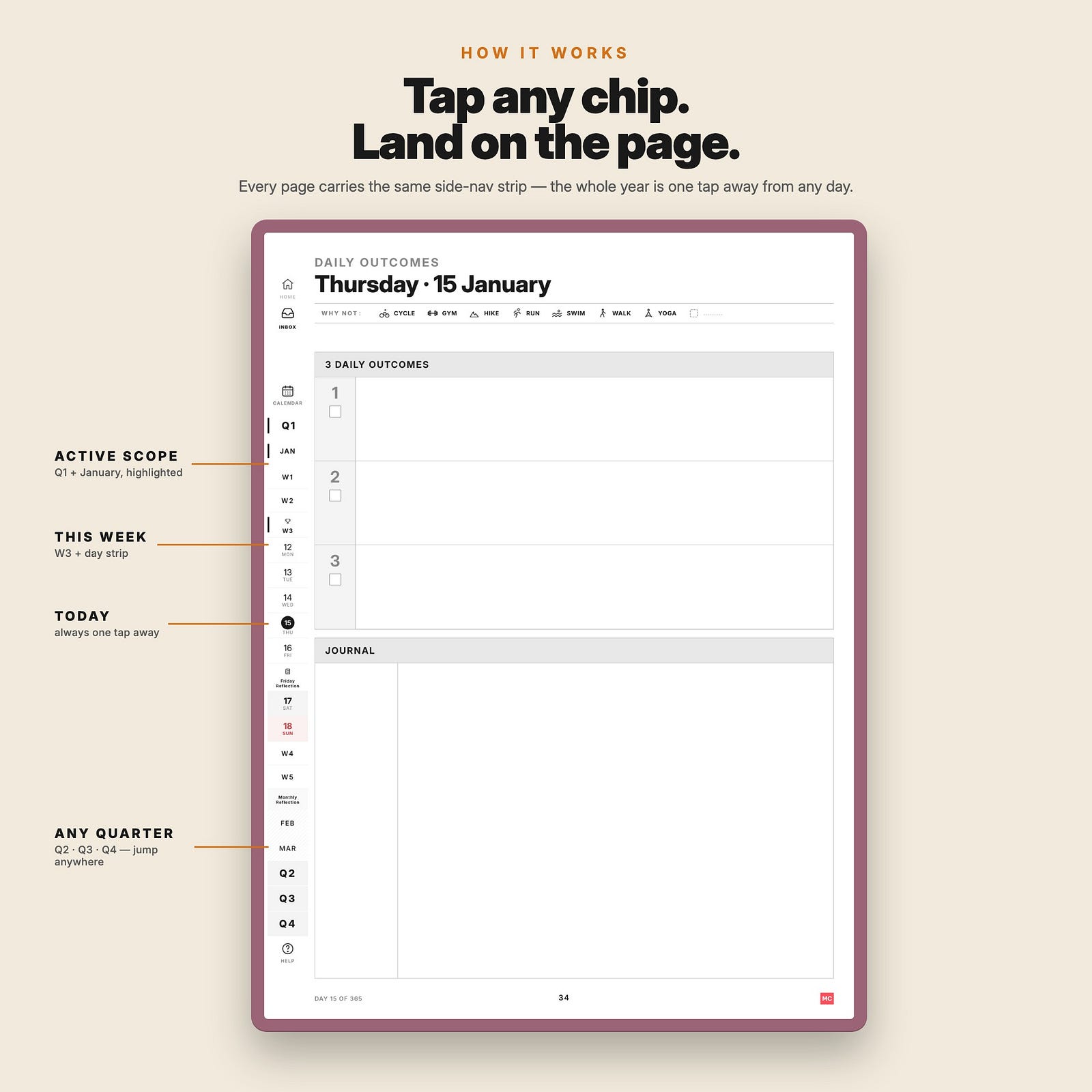
What replaced the streak grid is almost aggressively boring: the spine of each day is three lines — three outcomes you want to have finished by tonight, past tense, “shipped the report,” not “work on report.” There’s room under them to journal, and a quiet check across the parts of life a good week keeps in balance — mind, body, work, relationships, the rest. What there isn’t is a single box that carries yesterday into today.
You write your three, close the page, and go do them. Tomorrow opens clean. Nothing on it remembers what you skipped — so there is nothing to break.
Why “nothing to break” is the actual feature
Every system that survives real life has this property: it tolerates gaps. Not because gaps are good, but because gaps are inevitable, and a system that assumes you’ll never miss is a system designed for a person who doesn’t exist.
Perfectionism is the thing that kills planners. Not laziness — perfectionism. The instinct that says “I broke my streak, the month is ruined, I’ll start clean in January.” A planner with a streak counter feeds that instinct with fresh evidence every single day. A planner with no memory of failure starves it.
Three more design choices fell straight out of that one:
- You can start mid-week, mid-month, mid-year. There’s no “day 1” to honor or dishonor. Your year is the next twelve weeks, starting whenever you open the file. The “I’ll start fresh next quarter” instinct is just streak-shame wearing a calendar.
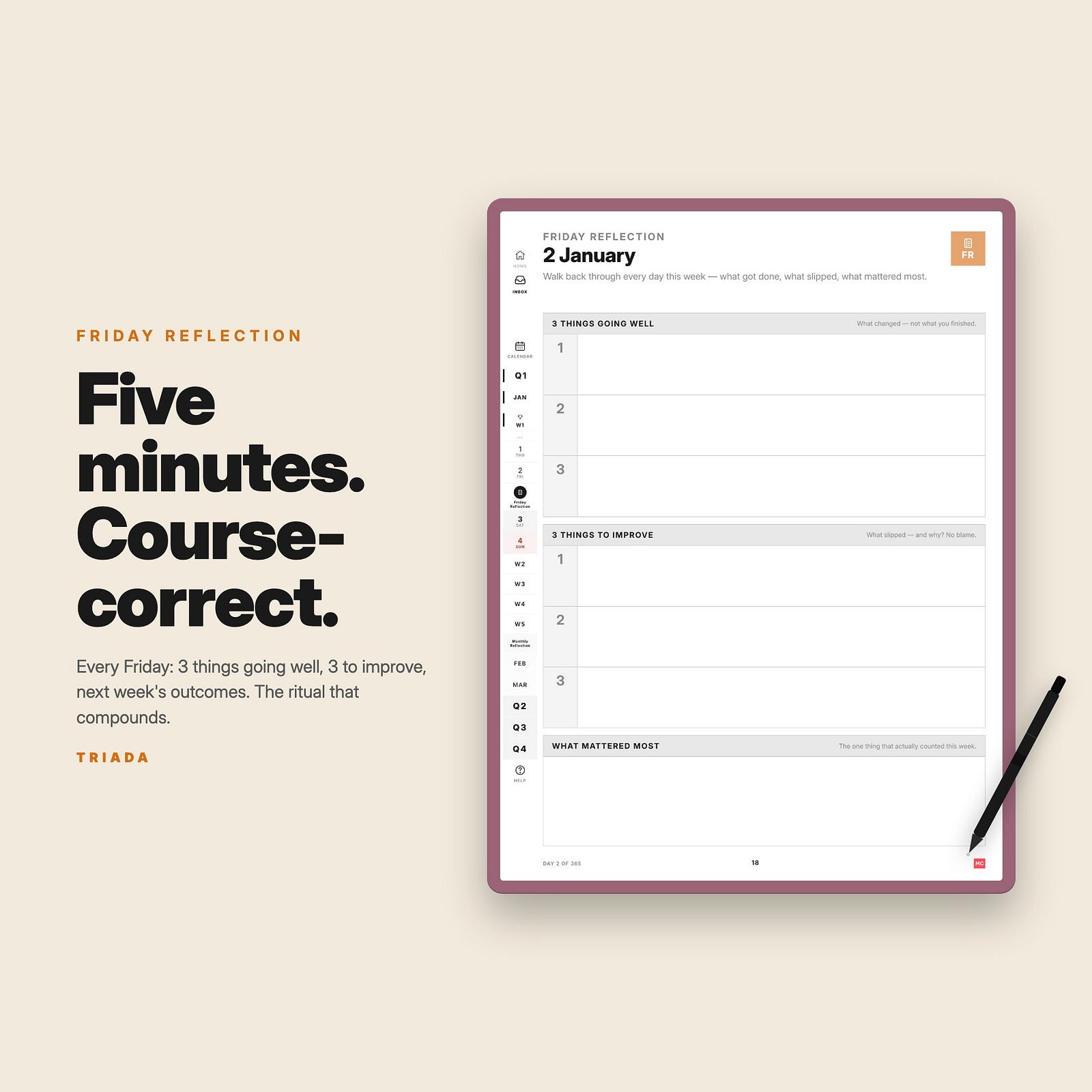
- Friday, you look back — briefly, and without a scorecard. Five minutes: what went well, what to improve, the one thing that actually mattered this week. Not “how many boxes did you tick.” A course correction, not a report card.
- Three outcomes, never more. Few enough that a bad week still fits inside three lines. A to-do list of fifteen items is just a streak grid with extra steps — a longer record of everything you didn’t get to.
Two years in, I still miss days. I missed four days last month. I know that only because I counted for this article — the planner certainly didn’t tell me. I just opened it on day five, wrote three lines, and kept going.
A planner that punishes you for missing a day is a planner that punishes you for being human. Delete the tracker. Keep the practice.
If you want the one I built
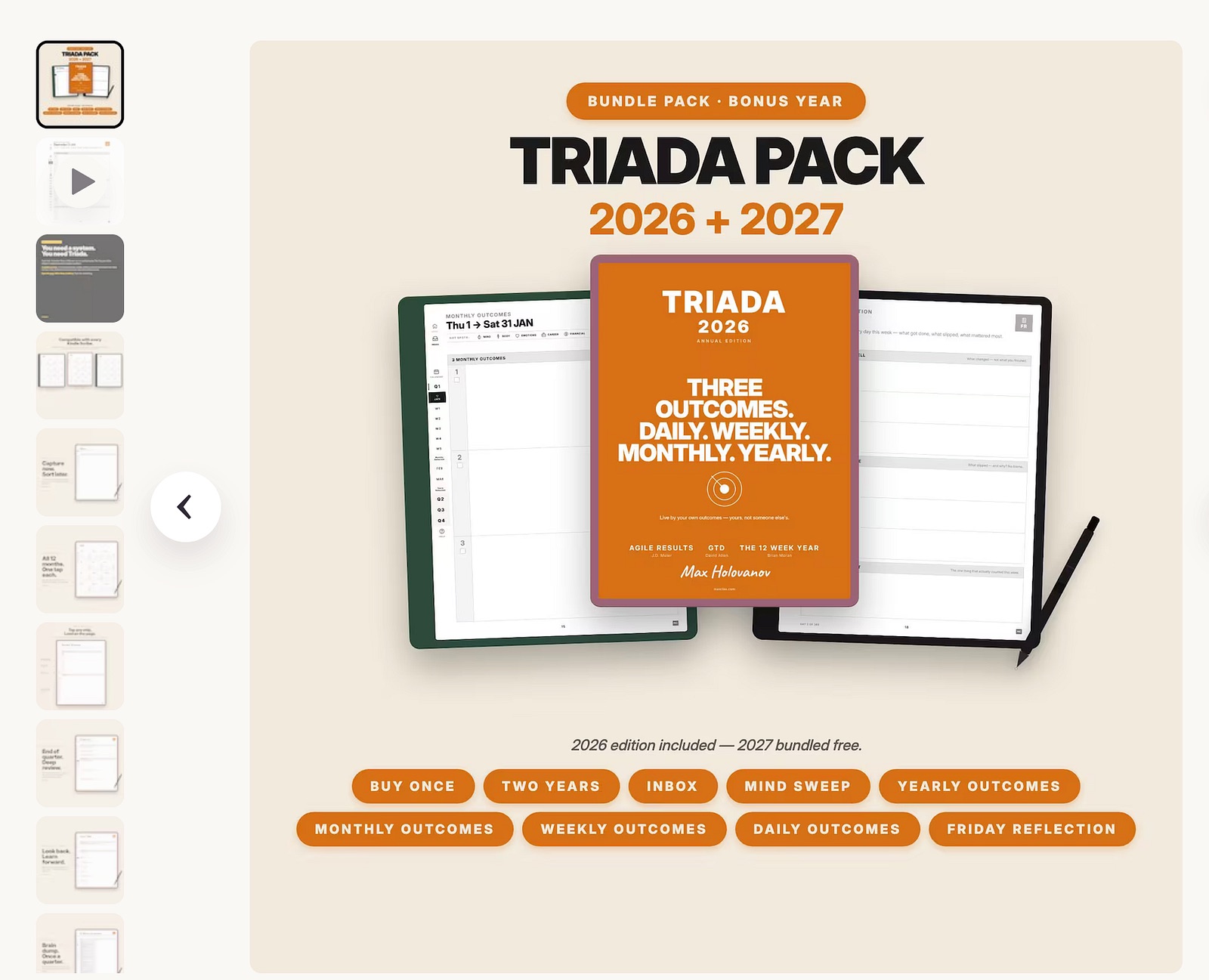
I turned all of this into a hyperlinked PDF planner for e-ink — Kindle Scribe, reMarkable, Supernote, Boox, and iPad. Rule of Three at every level, Friday reflection a few taps away, and — the whole point of this article — no streak counter anywhere in it.

Start where every good decision starts: try it before you spend anything. The free sample isn’t a teaser — it’s the real first ~62 pages, front matter through all of January, the exact design and structure of the full edition. Flip through it on your own device tonight; use January from the sample as your actual January if you like it.
- Free sample (Monday-start): triada-sample.pdf
- Free sample (Sunday-start, US/Canada): triada-sample-sunday.pdf
If it fits, the full edition — every month of 2026 and 2027, all systems hyperlinked and ready to pin to your device — is here: Triada 2026–2027.
If you’ve found your own way off the streak treadmill, I actually want to hear it — drop a comment. And if you skipped a day this week and opened your planner anyway: that’s the entire skill. Nothing to break.
Thanks for reading. Follow on X: https://x.com/maxclaxOS
Dotfiles: https://github.com/maxclax/dotfiles
Related: