 SUNCLAX

2/ A Busy Day and a Good Day Are Not the Same Thing
How I actually run my life on three outcomes — Part 2 of 6.
You set three. The day offers thirty.
→ 1/ Most Weeks Don't Get Planned. They Just Happen to You.
In Part 1 (above) you set the week and handed today its three. Now the day opens, and the world tries to hand you thirty. A message, a meeting, a “quick” favour, the thing that’s on fire but isn’t yours.
That’s not a failure — life happens, urgent things land. The skill isn’t sealing the day off. It’s a question you ask in the moment, over and over: is this mine, or someone else’s?
Because here’s the trap nobody warns you about: you can spend eight hours moving fast, close every loop, empty the inbox — and not touch one of your three. You’ll feel exhausted and accomplished and slightly hollow, and you won’t know why. A busy day and a good day are not the same thing. Busy is motion. Good is motion pointed at what you decided mattered.
Three, and star the one that’s really yours
So every morning, before the day fills, write today’s three again — and mark the one that points straight at a weekly outcome. That’s the one you protect first, before the noise arrives, because it’s the one the day will most want to quietly drop.
The other two can flex. The starred one is the thread back to the week. When you look up at 4pm wondering where the day went, it’s the thing that tells you whether the day was yours.
Two lines before you plan — look back, then forward
There’s a second half to the day that most people skip, and it costs thirty seconds. Before you set today’s three, glance at yesterday — two honest lines, no more:
- What actually happened yesterday?
- What does that tell me about today’s three?
Then set today, shaped by what you just saw. That’s the loop: a look back, then aim forward, same page, same morning. Do it for a week and you stop guessing where your time goes — you can see it. People skip the look-back because it feels like extra work. It isn’t. Two honest lines beat a blank “productivity system” every time.
The outcome that never makes the list
One more, because it’s the first thing that falls off a busy day: move your body. Not for a streak, not for a goal — because a body that moves thinks better, sleeps better, and makes every other outcome easier to reach.
You don’t need a plan. Cycle, gym, walk, run, swim, yoga — pick one, twenty minutes counts, and make it one of today’s three so it isn’t the thing that quietly gets dropped when the day fills up. A “great” week of shipped tasks with your body falling off the edge isn’t a great week. It’s a bill arriving later.
How the planner holds it
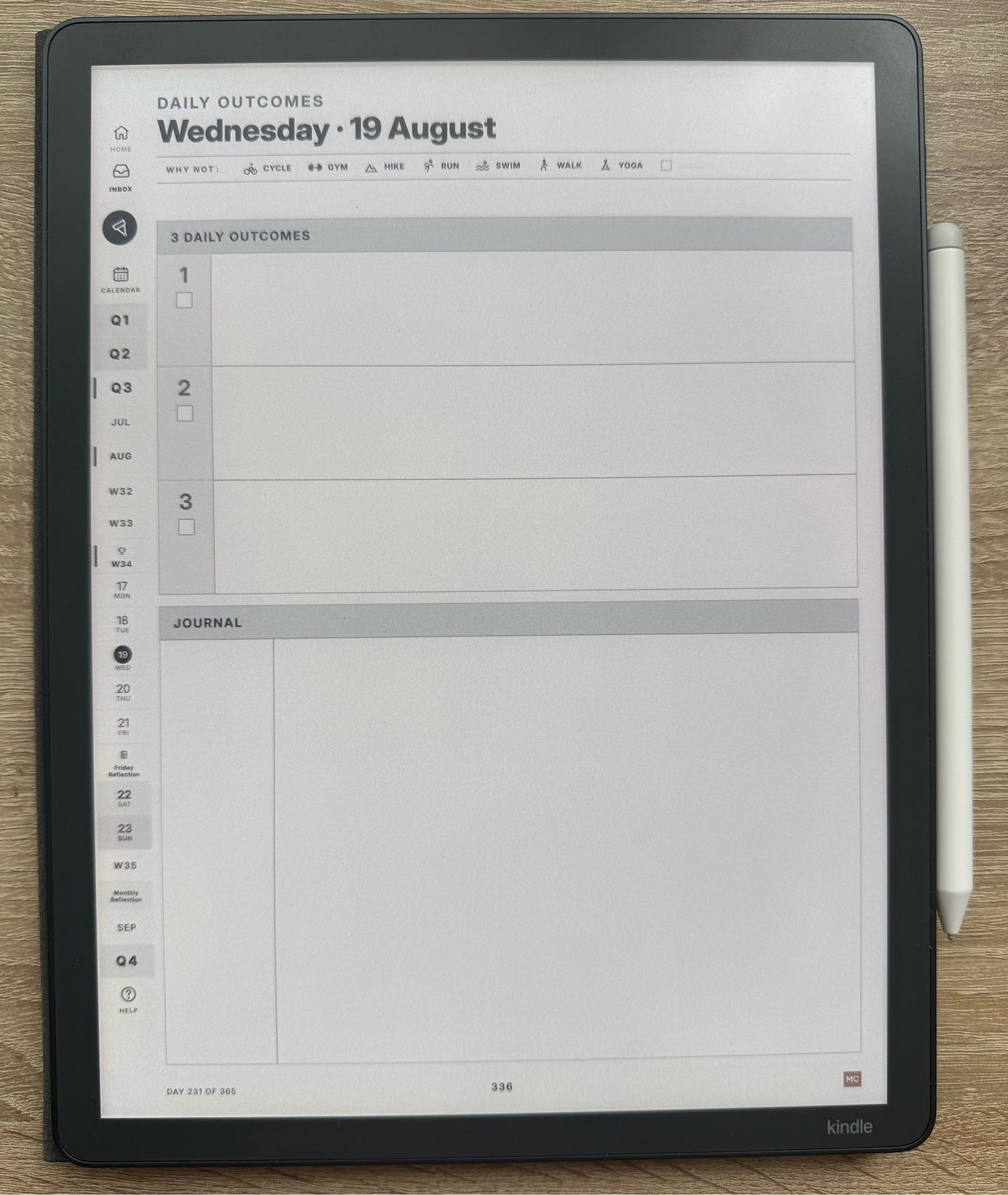
In Triada the pieces sit where the day needs them: the three outcomes up top, the journal block right under them so yesterday’s two lines are one flip back, and a “why not move” row across the daily page — cycle, gym, hike, run, swim, walk, yoga — so the nudge is in front of you. Tick it on the days you move; no guilt on the days you don’t. And your weekly three are one tap from any day, so “what was I aiming at?” is never a guess.
Paper does all of this too. The planner just keeps the pieces one flip apart instead of scattered across four apps.
Today
Three outcomes. Star the one that serves the week. Two lines on yesterday first. And make one of the three move. Protect the starred one before the noise lands — that’s the difference between a day that was busy and a day that was yours.
Next: Friday. The ten minutes that decide whether this week compounds into the next or vanishes.
Thanks for reading. Follow on X: https://x.com/maxclaxOS
- Free sample (Monday-start): triada-sample.pdf
- Free sample (Sunday-start, US/Canada): triada-sample-sunday.pdf
- See the full edition + device variants: https://maxclax.com/triada
The series — How I run my life on three outcomes:
- Most Weeks Don’t Get Planned. They Just Happen to You.
- A Busy Day and a Good Day Are Not the Same Thing (you’re here)
- Without These Ten Minutes on Friday, Every Week Starts From Zero
- Close the Month Before You Start the Next One
- The Year Has a Lie Built Into It: There’s Always Next Year
- A Quarter Just Ended — Which Means You Just Finished a Year