 SUNCLAX

An Ayurveda Center, the Down Dog App, and Years of Systems. Only Yoga and My Body Stayed.
The one practice that came home with me
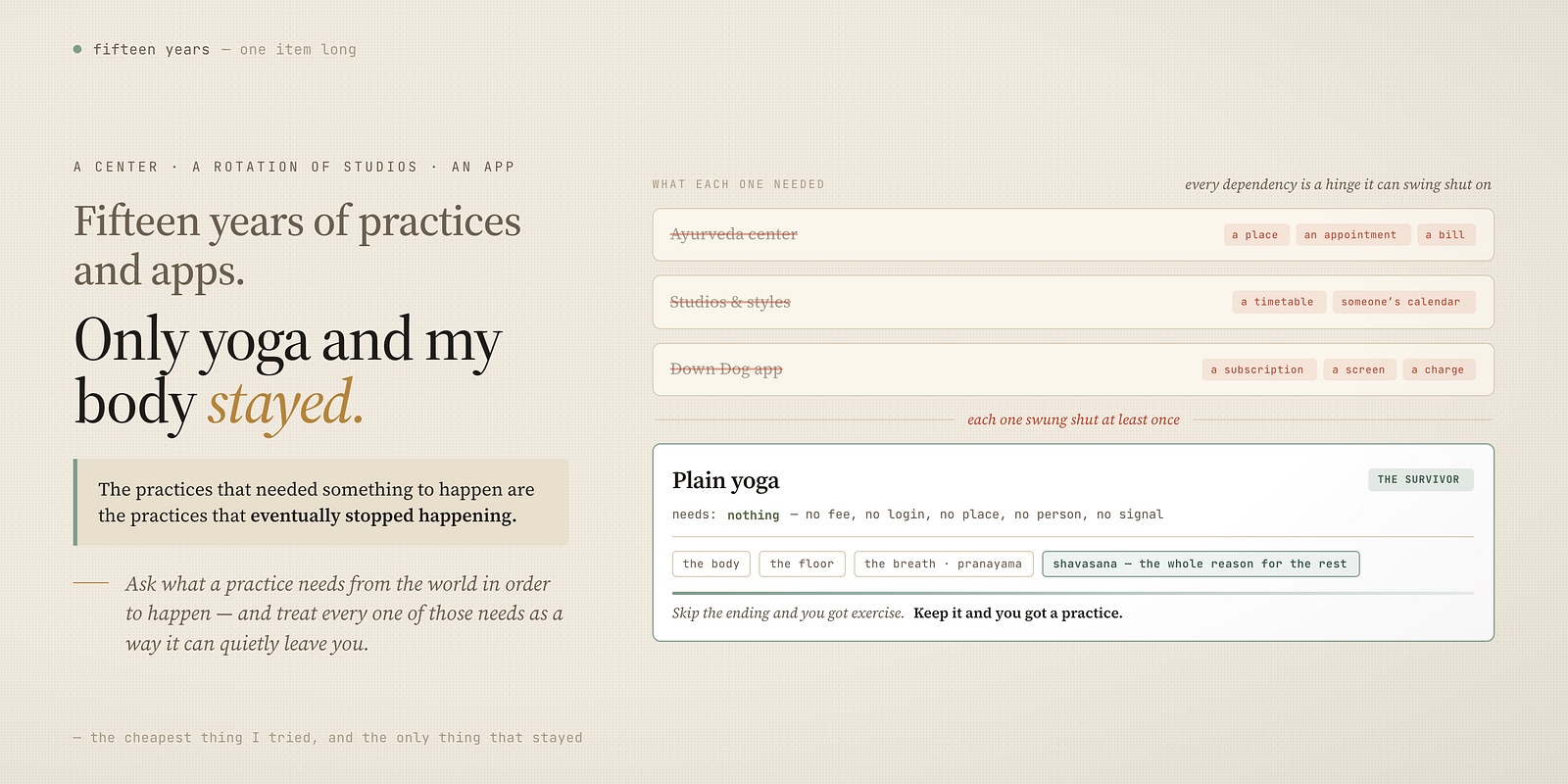
For about fifteen years I’ve been trying to feel better in my own body, and I tried it the way most people do now: by adding things. An Ayurveda center, with its treatments and protocols. A rotation of studios and styles. Apps — the good ones, the Down Dog kind that build you a fresh session every morning so you never repeat and never get bored.
I don’t regret any of it. Some of it worked for a season. But when I look back honestly across fifteen years and ask which of it is still with me — not admired, not lapsed, actually practiced, this week, without my deciding to — the list is one item long.
Plain yoga. My body, the floor, and nothing else.
Almost everything I tried had a meter on it
Here’s the pattern I only saw in hindsight. Nearly every practice I picked up came with something attached — a fee, a login, a place I had to travel to, a person whose calendar I had to match. The Ayurveda center was good, and it was also an appointment and a bill. The app was clever, and it was also a subscription and a screen I had to prop up where I could see it.
None of that is a scandal. But every attachment is a reason the practice can stop. The studio changes its timetable. The subscription lapses. The phone is charging in the other room. Each dependency is a small hinge the whole habit can swing shut on, and over fifteen years I watched every one of them swing shut at least once.
The practices that needed something to happen are the practices that eventually stopped happening.
The one that had no dependency had nothing that could fail. That, more than any special quality of the yoga itself, is why it’s the survivor.
What stayed needs nothing
What actually lasted is the least impressive thing I do. No equipment beyond a mat I could do without. No app building me a clever new sequence. No cost after the first time someone showed me how. Just the traditional shape of a practice: move the body through its range, let the breath drive it, work with your own weight instead of against a machine.
It isn’t expensive, and that turns out to matter more than I expected — not because I couldn’t afford the alternatives, but because free means there’s no moment where a payment reminds me this is optional. Nobody is billing me for it, so nobody can cancel it. Only I can, and I keep not doing that.
The un-appified version has one more quiet advantage: it doesn’t chase novelty. The app’s whole promise is that today will be different from yesterday. Traditional practice makes the opposite promise — today is the same as yesterday, and the sameness is the point. You’re not there to be entertained. You’re there to repeat something until it starts to repeat you.
You finish on the floor
The part I’d defend hardest is the ending, because it’s the first part every hurried version drops.
A traditional practice doesn’t stop when the last effort is done. You come down to the floor, you stretch out what you just worked, and then you lie completely still — shavasana, the pose that looks like nothing and is the whole reason for the rest of it. You do nothing, deliberately, until the effort settles into the body instead of evaporating off the top of it.
Skip that and you got exercise. Keep it and you got a practice. The difference is a few minutes of lying on the ground doing what looks, to anyone watching, like giving up — and it’s the few minutes I notice most on the days I’m tempted to cut them.
Now they want to sell you the quiet part too
The newest move — and you’ll see it in the same apps — is to bundle meditation in. One subscription, and the app that stretches you will now also calm you, in a soothing recorded voice, for a little more a month.
I’d gently push the other way. The meditation that has held up for me isn’t a track I press play on. It’s breath — pranayama, slow and deliberate, until the breathing is doing the settling on its own. And it’s an inward practice I’d describe as filling: attention moving through the body’s centers, the chakras, one at a time, until I’m paying attention from the inside instead of listening to someone tell me to.
That costs nothing and needs no one. It’s the same lesson as the yoga, arriving from the other direction — the version that depends on a voice in an app is the version that stops the month you stop paying, and the version that’s just you and your breath is the one you still have when there’s no signal, no subscription, and you need it most.
Fifteen years, and the keeper asks for nothing
If there’s a thing to take from fifteen years of trying, it isn’t a style or a center or an app. It’s a test. When you’re deciding what to keep, ask what each practice needs from the world in order to happen — a payment, a place, a device, a person — and treat every one of those needs as a way it can quietly leave you.
The practice I still have is the one that asked for nothing. Just a body, some floor, the breath, and a few honest minutes at the end lying still. It was the cheapest thing I tried and the only thing that stayed, and after fifteen years I’ve stopped believing that’s a coincidence.
Thanks for reading. Follow on X: https://x.com/maxclaxOS