 SUNCLAX

Obsidian and Notion Gave You a Second Brain. This Free Film Gives It Tools.
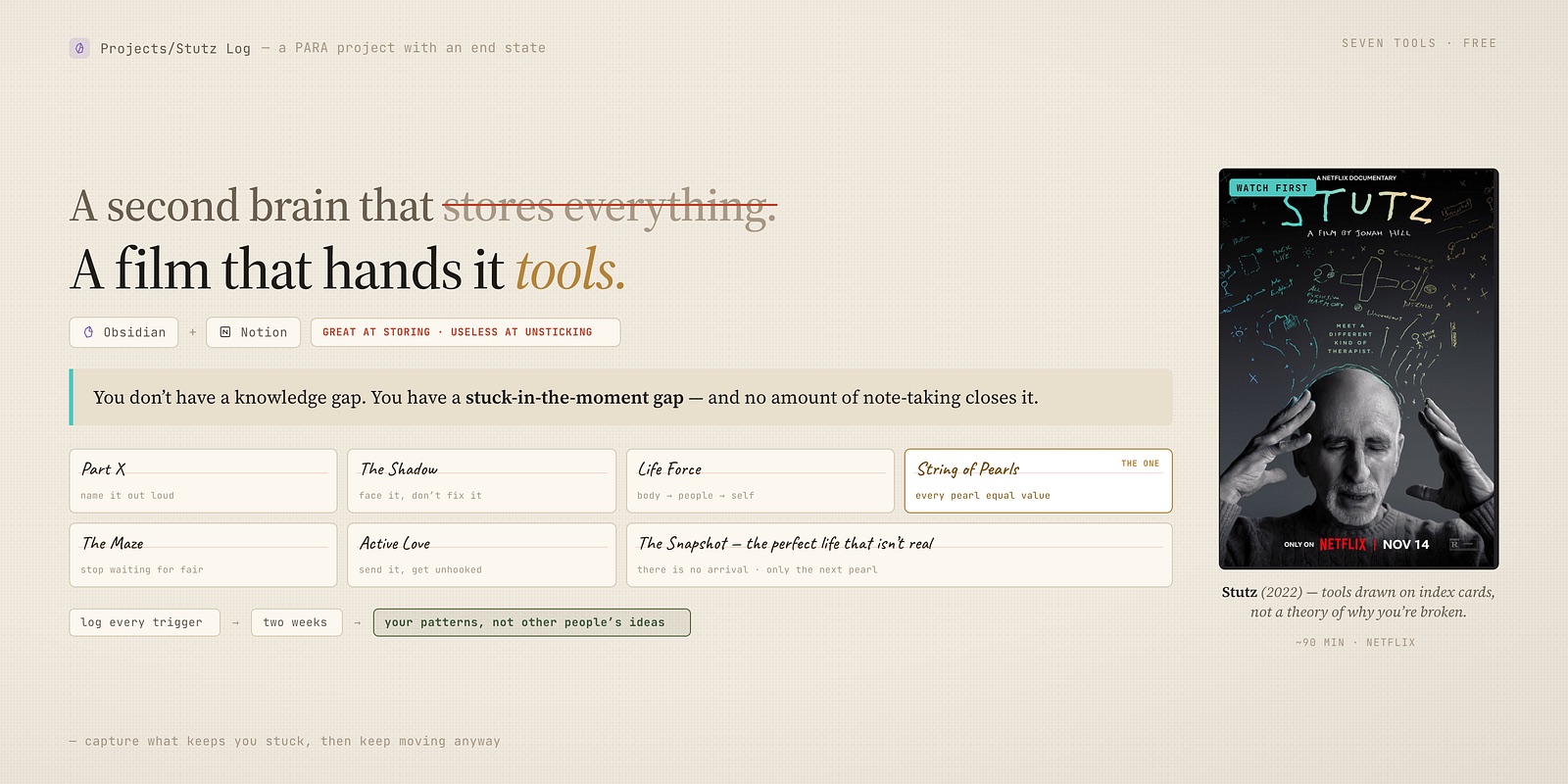
Your second brain is enormous. It hasn’t moved you an inch.
Let me guess. You have a vault. Hundreds of notes, a tidy PARA structure, plugins you spent a weekend configuring, a graph view that looks like a galaxy. It is genuinely impressive. And when you’re actually stuck — frozen on a project, resentful, telling yourself this is pointless — none of it does a single thing for you.
That’s not a knock on Notion or Obsidian. They’re brilliant at storing. They’re just useless at unsticking, because storage was never the problem. You don’t have a knowledge gap. You have a stuck-in-the-moment gap, and no amount of note-taking closes it.
What closes it is a set of tools — and the best ones I’ve found didn’t come from a productivity channel. They came from a film, and they cost nothing.
Recommendation number one: watch the film
Before anything else — if you haven’t seen Stutz, stop and watch it. That’s the first and biggest recommendation in this whole piece. It’s on Netflix, it’s about ninety minutes, and it’s the rare self-help thing that doesn’t leave you with a mood — it leaves you with tools.
Stutz (2022) is a documentary Jonah Hill made about his own therapist, Phil Stutz — a psychiatrist who, with Barry Michels, wrote a book literally called The Tools. It’s shot in black and white, it keeps breaking its own fourth wall, and at some point Hill admits the film itself is a bit of a mess. That honesty is the point. What Stutz teaches isn’t a theory of why you’re broken. It’s a set of concrete, do-it-right-now moves he draws on index cards, made for the exact moment you’re stuck.
Everything below is a summary. It is not a substitute for the film — watch that first. Then come back and use this as the cheat sheet.
Part X — the voice that wants you to quit
Part X is your inner enemy. It’s the voice that says this is impossible, give up, you’re a victim, why bother. Stutz’s key move is that Part X isn’t you — it’s an impersonal force, the part of the universe that blocks growth, and it shows up in everyone.
How to use it: name it out loud. When the voice starts, you say, “That’s Part X.” The second you label it as a separate force instead of the truth, it loses its grip. You stop arguing with yourself and start pushing against something outside you. Part X never fully leaves — the goal isn’t to kill it, it’s to recognize it fast and keep moving anyway.
The Shadow — the part of you you’re ashamed of
Your Shadow is the version of you that you’d rather nobody saw — the embarrassing, weak, unimpressive part you keep hidden. The problem isn’t that it exists; it’s that rejecting it drains you.
How to use it: picture the Shadow as a person standing in front of you. Talk to it. Ask how it feels to be hidden and disowned by you all these years. Then accept it — not fix it, accept it. Stutz’s insight is that your relationship with your Shadow sets the ceiling on your confidence: the parts of yourself you can’t face are the ones that run you from the dark.
Life Force — what to work on when you’re completely lost
When you don’t even know where to start, you go to the Life Force — a pyramid with three levels. Bottom: your body. Middle: your relationships with people. Top: your relationship with yourself.
How to use it: start at the bottom and work up. The body is first because it’s the most reliable lever — move it, sleep, eat, and everything above gets easier. Then people: reach out, don’t isolate. Then yourself: the private channel — writing, journaling, meditation — where you actually hear what you think. When you’re lost, you don’t need the perfect answer. You need to strengthen one of these three, and momentum comes back.
String of Pearls — the one that changes everything
This is the tool that quietly reframes a whole life. Picture a string of pearls. Every action you take is one pearl added to the string. Do the work, add a pearl. Write the page, add a pearl. Send the email, add a pearl.
The radical part: every pearl has equal value. The brilliant day and the just-showed-up day are the same size on the string. Motivation, inspiration, whether it was any good — none of it matters. What matters is that you added the next pearl.
How to use it: stop waiting to feel ready and just put down the next pearl. And Stutz adds a warning — sometimes inside the pearl there’s a jerk (his word is blunter): the resentment, the ingratitude, the “this isn’t fair.” Doesn’t matter. The jerk comes free with the pearl. You add it anyway.
The Maze — the trap of waiting for fairness
The Maze is where you get stuck in the past, replaying who wronged you and waiting for the scales to balance before you’ll move on. It always involves another person and a sense of unfairness. And it feels productive — like you’re owed something and pursuing it — but it’s just you, frozen, refusing to move until the world apologizes. The world won’t.
How to use it: you don’t reason your way out of the Maze. You use the next tool.
Active Love — how you get out of the Maze
Active Love is what frees you from the resentment keeping you in the Maze.
How to use it: close your eyes. Imagine the entire universe around you is made of love — a warm, dense field in every direction. Feel it concentrate and pour into your heart. Then take all of that love and send it, deliberately, to the exact person you’re angry at. You’re not doing it for them. You’re doing it to unhook yourself from the Maze so you can move again. The relief is the point.
The Snapshot (the Realm of Illusion) — the perfect life that isn’t real
The Snapshot, also called the Realm of Illusion, is the airbrushed picture in your head of the perfect life — the version where you’ve arrived, everything’s handled, and you’re finally happy. It feels motivating. It’s actually poison, because it isn’t real and it never comes, so measuring your actual life against it guarantees you feel behind.
How to use it: recognize the Snapshot as an illusion and refuse to chase it. There is no arrival. There’s only the next pearl. You give up the fantasy of the finished, perfect life in exchange for the one thing that’s actually real: forward motion, one small action at a time.
The thread through all seven
Read them together and one idea runs through everything: you will never feel finished, and that’s fine — the work is to keep moving anyway. Part X says stop; you name it and keep going. The Snapshot says you haven’t arrived; you drop it and keep going. The Maze says wait for justice; you send love and keep going. String of Pearls is the whole philosophy in one image: not a perfect life, just the next pearl.
Which is also, unglamorously, a problem of daily practice. The tools work in the moment. But “keep adding pearls” needs somewhere to live between moments — or Part X quietly wins by attrition.
Put the vault to work: one project, every trigger
Here’s where your second brain finally earns its keep — not as a library, as a mirror. This is my actual recommendation, the thing to do the moment the credits roll.
Open Notion or Obsidian and make one new Project in your PARA setup. Call it “Stutz Log” or just “Triggers.” From now on, every time one of these forces shows up in real life, you log it — one line, timestamped:
- Part X spoke → write down exactly what it said. “You’ll never finish this.” “Who do you think you are.”
- A Shadow flinch → the thing you were ashamed of in that moment.
- You caught yourself in the Maze → who it was about, and what “unfairness” you felt owed.
- You chased a Snapshot → what the perfect picture was that made your real life feel like failure.
- You added a pearl anyway → log that too. Especially that.
It goes in Projects, not Resources, on purpose: it has an end state. The project is becoming aware of these forces, and once the awareness is automatic you archive it.
Do this for two weeks and your vault does something no pile of clipped articles ever has: it shows you your patterns. The same Part X sentence, on repeat. The same two or three Shadows. The exact Maze you keep re-entering with the exact same person. That’s not note-taking. That’s the raw material of actually changing — and it’s the first time the huge system you built is pointed at you instead of at other people’s ideas.
Capturing the triggers is the study half. The other half is daily forward motion — and that I keep somewhere deliberately simpler.
How I ground this day to day
This is where a plain planner turns out to matter more than another app of affirmations. I run mine on the same shape these tools point at — and deliberately without the one feature that feeds the Snapshot.
- String of Pearls → three outcomes a day. Each day I write just three outcomes and do them. Three pearls, added. Not fifteen, not perfect — the next three. A page that fills whether the day was brilliant or barely.
- No streak grid, on purpose. Most planners are a Snapshot machine: a wall of little circles measuring you against the perfect unbroken chain. Miss one and the tracker turns into a record of failure. Mine has no streak counter anywhere — because the Snapshot is exactly the illusion Stutz says to stop chasing. Skip a day, tomorrow’s page opens clean. Nothing to break. Just add the next pearl.
- Life Force → the balance built into the page. The daily page has a move-your-body row (the base of the pyramid), the weekly page has a life-areas check across mind, body, relationships and the rest (the middle), and there’s a journal block under each day (the top — your channel to yourself). The three levels of the Life Force, printed where you’ll actually see them.
- The Maze → reflection instead of rumination. A short Friday and monthly reflection ask what worked and what’s next — a way to process a week and let it go, rather than sit in the Maze relitigating it.
Today
Watch Stutz — that’s still recommendation number one. Then do two small things: open a new PARA project and start logging your triggers, and pick one tool to actually use today — name Part X when it starts, send Active Love to someone you resent, or just add a single pearl and stop waiting to feel ready.
Your vault studies the pattern; a clean daily page keeps the pearls coming — three outcomes, no perfect picture to chase, no chain to break. That’s the whole idea: capture what keeps you stuck, then keep moving anyway.
Thanks for reading. Follow on X: https://x.com/maxclaxOS
- Free sample (Monday-start): triada-sample.pdf
- Free sample (Sunday-start, US/Canada): triada-sample-sunday.pdf
- See the full edition + device variants: https://maxclax.com/triada