 TEMPO
 SUNCLAX
GLP-1 W2: Mounjaro at 2.5. Quieter Head, Harder Heart
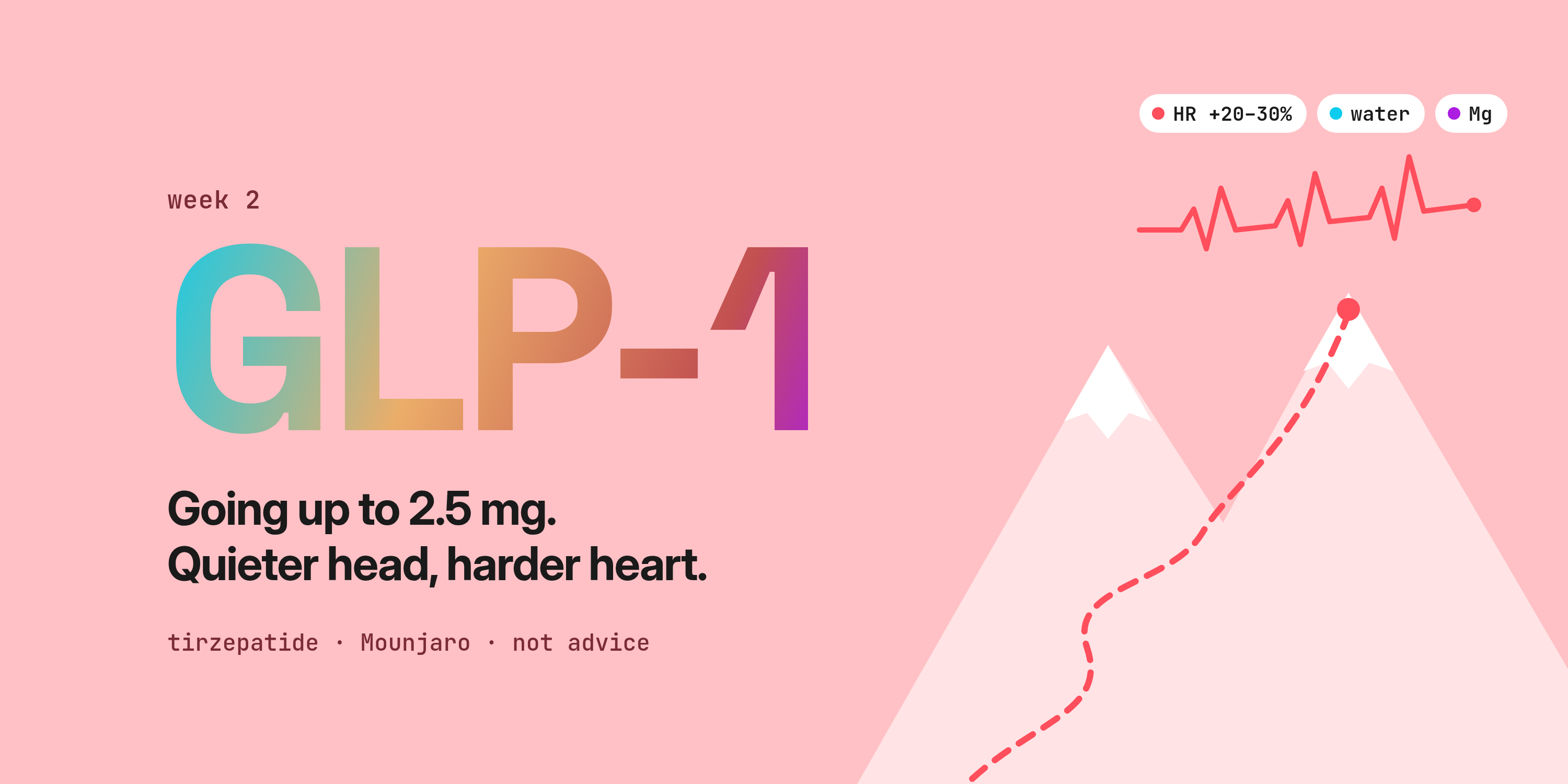
Going up to 2.5 mg: my head, my heart rate and the must-haves I keep at hand. My own Mounjaro notes, logged day by day. Not advice.
If you haven't read GLP-1 W1: I Started With 2,000+ Strava Activities. The Honest Truth yet, read it first. It's important. Everything in the weeks that follow only makes sense once you know where I started and how.
This is part 2 of my GLP-1 series. In Week 1 I wrote why I started: not the weight, but a fog in the head and a hard hunger after long rides. I started at 1.25 mg, logged everything in Tempo from day one, and spent the week in between looking for reasons not to go up to 2.5. I didn't find any.
A separate area for GLP-1
After the first week my journal had a lot of GLP-1 entries, mixed with everything else: work, rides, home. So I gave it its own area in Tempo.
An area is a focus. I named it GLP1 and put it under Mind and Body, next to Fasting. I picked an icon and set one tag: glp1. Now every entry with #glp1 lands there by itself. One tap, and I see only this: the notes, the doses, keto and glucose, day by day.
That's the perspective I need for analysis. Not my whole life in one feed, just this one experiment, and how it changes from week to week.
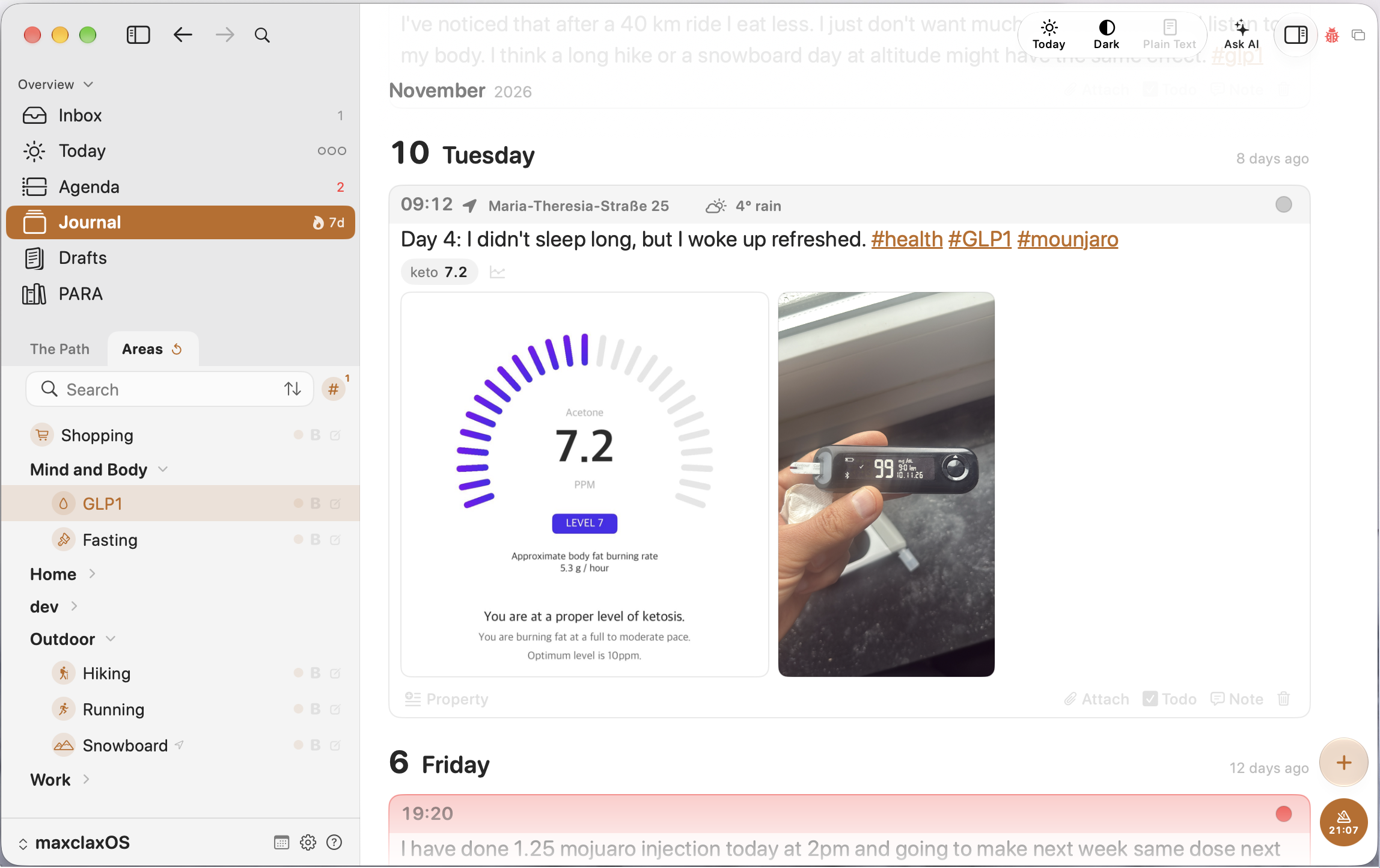
Dose two: 2.5
Friday morning, 2.5 mg.
The same shiver right after the shot. This time I knew: it's an inner fear I can't fully control. It comes from all the warnings online, often from people who market their GLP-1 article and never tried it themselves.
Until day three I felt nothing new. If anything, I felt the first dose letting go: the dryness was passing.
On day three, a calm came. Not clarity. More like something final. The pile of urgent things just fell away in my head, as if something cut them off, and that was it.
I don't think that's the drug itself. I think it's sugar dropping. It comes with sweets, with what we eat.
Since the very first shot I stopped eating sweets completely. Not because I'm fasting and not on principle. I just don't want them. No more one candy, then the second, the fifth, the tenth, half a bar of chocolate.
Calm, not clarity
I want to be honest here: there's no clarity yet in week 2. There is calm. The urgent things stopped pushing.
I never got this from pills. Not from thiamine, not from valerian, not from ashwagandha. It came by itself as my sugar level went down.
But it didn't stay calm. Later in the week, that calm turned into apathy. More on that below.
My heart works harder
This is an important one.
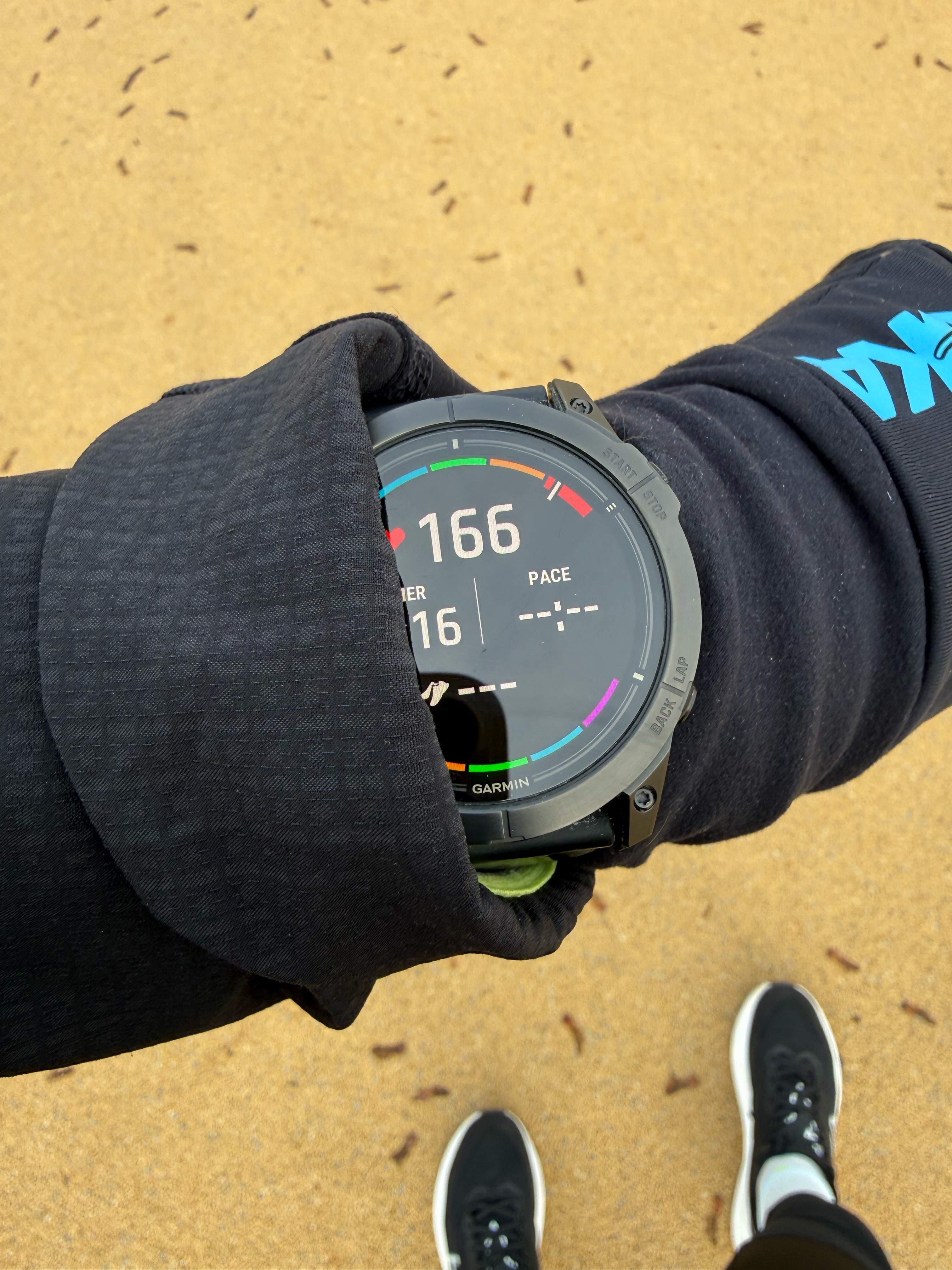
- On the bike: 20–30% higher. At my usual pace, the same rhythm, where I used to ride at about 130, it's clearly above that now.
- Running: 160–170 instead of 130–140. That's in what used to be an easy Garmin zone.
My theory: the heart has to work more because energy is spent somewhere else. But I know this exact feeling from regular fasting. After two or three days on water, once ketosis kicks in, I get the same light weakness. Like when you sit on the floor and stand up fast and see little stars.
It's all controllable. There was no moment that made me think I shouldn't have started, or shouldn't have taken the dose.
A sudden jump in heart rate at the same effort is still something to show your doctor. I'm watching mine in the log and on the watch.
Water, electrolytes, magnesium: my must-haves
When I started, I already had magnesium at home (iHerb): Thorne, citrate and gluconate, 120 mg per capsule. For me this is simply a must. I took it before too, but on Mounjaro I started taking bigger doses.
My routine now: in the morning two tablets of 120 mg, so 240 mg, with breakfast. In the evening, four more capsules, another 480 mg.
After the 2.5 dose, the first evening my neck and back started to pull, the places where I usually feel tension. I thought maybe it was a plank, or a whole day sitting in meetings. Next morning: no vomiting, no headache. On day three a slight headache came, not strong. My first thought was: a bit more water and it will be OK. And it was.
In the second week I understood something simple. When something starts to ache somewhere far away, or my head, or some small discomfort, I just drink water. And it goes away. No problems. You eat less, but more often, and you drink water.
I add electrolytes to the water. Ordinary sports electrolytes, no sugar, nothing else. Just electrolytes. It helps a lot.
I don't track water on a chart. I simply started drinking more and watching how I feel. Right now, at the time of writing, it's about two to two and a half liters a day, with electrolytes added.
In the morning I also take creatine, 3.5 g, to help hold water in the body.
For me these belong to what you must have at hand from day one:
- Magnesium. Thorne, citrate and gluconate: 240 mg in the morning, 480 mg in the evening.
- Electrolytes. Plain sports electrolytes in the water, no sugar.
- Creatine. 3.5 g in the morning.
- Water. About two to two and a half liters a day, by feel.
This is what works for me, not a prescription. Doses and supplements are something to check with your doctor, especially if you take other medication.
magnesium:: 240
creatine:: 3.5
This is not a fat burner
My goal is not to lose half my body weight. Yes, I want to remove some stubborn fat, up to about ten kilos. But the main goal is to build the right habits along the way.
And I'm not going in the direction of maximizing the dose. I'm not going in the direction of losing muscle either. My main task is to find the minimal effective dose. On myself I can see that today, for me, that dose is 2.5.
GLP-1 therapy is not an easy way. It's not a fat burner, the way many people sell it to us. It's a real system, and hard work. Not a short way. You have to build your habits right, understand what works for your body and what doesn't.
Never inject it just as a fat burner and hope it's some kind of AI agent that will do everything for you. It isn't.
At this point I already understood that GLP-1 is presented the wrong way. Mounjaro and the rest will get better, of course. But I think medicine is heading somewhere big with this. Something like what AI is for the world of technology.
Is it hype?
I also follow how the GLP-1 trend grows, and in which countries.
I looked at the numbers before answering that for myself. Google searches for Ozempic, Wegovy and Mounjaro were almost flat until 2021, then took off: first in the US, Canada and Australia in 2023, then in the UK, Germany, Austria and Ukraine in 2025–2026 (Google Trends).
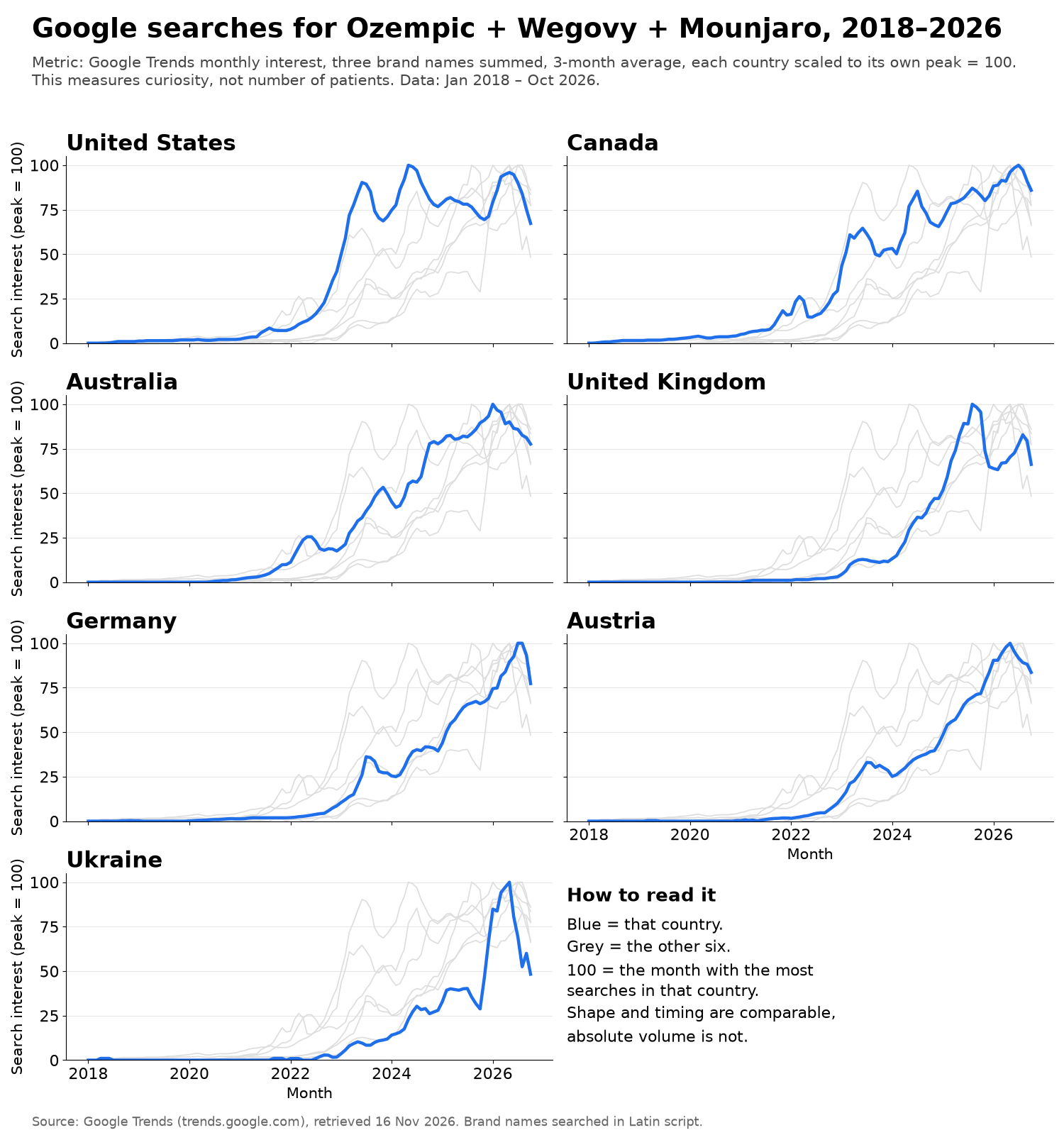
Searches are curiosity, not patients. Here are the real numbers I found:
- 12% of US adults take a GLP-1 drug right now. That's double the share from May 2024, and 18% have ever taken one (KFF poll, Nov 2025).
- Anti-doping doesn't ban it, but watches it. For athletes I found no solid numbers on how many use it. The World Anti-Doping Agency monitors semaglutide and tirzepatide in and out of competition (WADA 2026 Monitoring Program), and they stay allowed for 2027 while it studies their effect on trained people (BBC Sport).
- 2.9% of amateur athletes have already tried it. In a 2025 UK survey of 681 exercisers and recreational athletes, 2.9% had already used GLP-1 drugs off-label, and a quarter had thought about it (study).
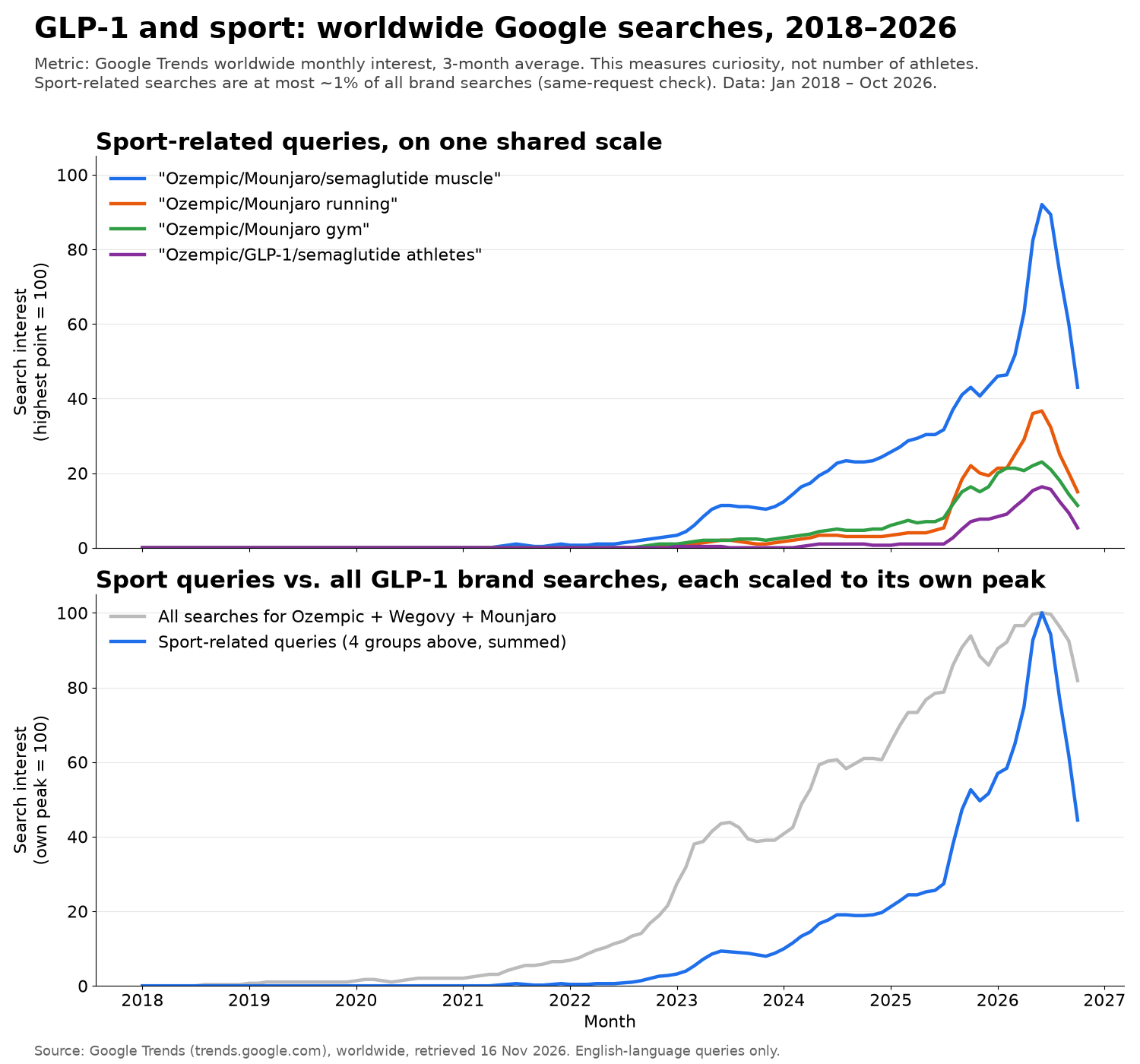
Worldwide, sport people started asking about it much later than everyone else: searches like "Ozempic muscle" or "Mounjaro running" barely moved until 2023 and really took off only in 2025–2026 (Google Trends). It's still a small corner, around 1% of all searches for these drugs or less, and the top question is clearly about muscle.
So for me it's not just hype. It's a mass trend that nobody has fully figured out yet, especially for active people.
Apathy before the next shot
Two days before the next dose, a heavy apathy came in. Not tiredness, more like nothing matters. I just wanted to do nothing. I didn't want to work, I didn't even want to watch TV. I didn't want anything.
It came like a crisis, and it felt very familiar. It's almost the same dip I know from fasting, when the body fully switches over to ketosis after hunger.
So I started searching. From what I found online, this drop in energy is common: many people report it around week 2 or 3. That doesn't make it go away, but it helps to know I'm not the only one.
What I read this week: microdosing
While searching, I also read about microdosing. Instead of one weekly 2.5 mg shot, some people split the dose: about 0.8 mg three times a week, Monday, Wednesday and Friday, or about 1 mg each time. The point is to flatten the peak and reduce side effects like weakness or nausea, if someone has them, while keeping the same effect. As I understand it, this is mostly for people on higher doses, 5 or 10 mg, who feel those side effects and want to smooth them out.
I'm deliberately not doing it. I don't have those side effects, so I see no reason to smooth anything. By week 2 my understanding is that it works cumulatively anyway. In week 3 I'll stay on one 2.5 mg shot a week.
What's next
In Week 3 I'll write about the rest of my time on the second dose, and about finding the minimal effective dose. For me, today, that dose is 2.5 mg.
If you want to log your own way, symptoms, doses as properties, and charts that show what really happens, that's exactly what I built Tempo for.
→ Tempo: plain-text journal with properties and charts
And if you prefer to log by hand, on paper or e-ink, I made Triada, a planner for iPad and Kindle Scribe. I wrote about why I built it here: I tried 7 planners on my Kindle Scribe. All seven died by April, so I built one.